It’s that time of year again; award season. Unfortunately we’re not talking about the red carpet kind where women dress in beautiful gowns and men don tuxedos. We’re talking about the far less glamorous but nevertheless important; business awards.
Entering business awards has the obvious advantage that if you win an award you gain industry recognition and publicity for your business but it’s not all about winning. There’s also the less obvious but significant benefit that award submissions are a great way to review your business and discover what you are doing right and what you could be doing better.
We’ve compiled a list of 2012’s business awards across several different categories. Entries have now closed for some of the awards listed below but this is all the more reason to put them in your calendar as you don’t want to miss out next year. It’s time to get cracking on those award submissions!
– Entries closed July 2011will reopen later in the year for 2013
https://ignitepr.com.au/wp-content/uploads/2013/10/Ignite-WebLogo011.png00igniteprhttps://ignitepr.com.au/wp-content/uploads/2013/10/Ignite-WebLogo011.pngignitepr2012-02-09 13:55:122013-12-26 00:01:36AWARDS – Generate awareness of your business
Companies want to see themselves in the media; online, print and broadcast, but what they are doing or saying in this space determines its relevance or value to that company. Let’s have a look at the basic steps involved in planning an effective and measureable PR campaign.
Firstly, you must know the company goals. What it is the company trying to achieve and how can PR work to help achieve them.
Who are you talking to? Determine who it is you want your campaign to communicate with, your target audience. Is it the people buying your products/services, prospective employees, local businesses? Here are 15 questions you can ask yourself to define your target market.
What are the brand messages? I’m a good corporate citizen. I’m a great business to work for. I deliver trustworthy and high quality products and services. Your key message is what you want your audience to learn from your campaign. It’s what you’ll use to relate and appeal to them. A PR campaign may very well have multiple key messages to attract different target audiences.
This is a very simplified outline of planning for a campaign but if you have these key elements determined it will help your tactical execution be more relevant and effective. Here are some tactical ideas to help achieve your communication goals.
Good PR influences an audience. It’s the voice, and if no-one is listening it is failing. It’s not good enough to just get any old type of coverage if it’s not achieving anything.
Here are a few good measures we use to help evaluate the outcome of a campaign and these are important to consider when planning your tactical execution.
1. Overall sentiment – we evaluate exposure by its overall sentiment (negative, neutral or positive). Does the newspaper article position the company positively or negatively? This is a measure of the general tone and it’s usually very obvious.
2. Supports brand messages – does the exposure include your key brand messages related to your company goals? This is what differentiates your company and if these aren’t included then the PR has failed.
3. Call to action – is your target audience encouraged to take action? A successful PR piece will incite a call to action like visiting your company’s website or calling your phone number or to think about changing behaviour. This is what allows your customer to take the next step and engage with your brand.
4. Support above the line campaigns – PR is in a unique position where it provides the opportunity to validate a company’s brand messages. Whereas advertising screams “buy me”, PR subtly informs consumers about reasons why “buying you” will benefit them. Any good exposure driven by PR should support above the line campaigns.
https://ignitepr.com.au/wp-content/uploads/2013/10/Ignite-WebLogo011.png00igniteprhttps://ignitepr.com.au/wp-content/uploads/2013/10/Ignite-WebLogo011.pngignitepr2012-02-06 11:42:412013-12-26 00:01:36Targeted strategy: a campaign that hits the mark
Most people have been in a new relationship and celebrated a special occasion such as Christmas with their partner. The common fear that arises around this time is what gift do I give that meets the Goldilocks and the Three Bears convention of not being too little or too much but just right?
Gift giving for clients should be approached much like gift giving in a new relationship; with caution. As we enter the holiday season, minds will shift from media releases and social media monitoring to more enjoyable tasks such as deciding what gifts to send your clients for Christmas. There are several things to consider when giving Christmas gifts to clients and to ensure you send a gift that is well received we have some helpful tips to guide your decisions. How long have you known the client?
You’ve been with your partner for one month and for Christmas you’ve decided to get her a pair of diamond earrings, too much, too soon? We think so. Much like a new relationship, a new client may be made to feel uncomfortable by an inappropriate gift, as the relationship has only just begun. It is important to consider how long you have known them and worked with or for them.
Gifts for everyone! The more the merrier right? Wrong.
As much as you’d like to shower everyone in your professional community with gifts to express your gratitude, there are some people that are simply off-limits. It is best to steer clear of the following:
Journalists – keep it professional, they will appreciate it more or simply something simple (food never goes astray in a news room)
Potential clients – if you are currently in negotiations with a potential client, it may appear like a bribe or ‘sweetener’ or trying to hard
Previous client – if you have just parted ways with a client, it may come across as groveling
What is an appropriate gift?
A Christmas gift for a client could be as simple as a card that thanks them for their business throughout the year and lets them know that you’re looking forward to an exciting 2012. A general rule to guide your gift giving is to keep it reasonable; gifts shouldn’t be over the top in expense or too cheap. Giving clients a Christmas gift should also be a genuine gesture, free of any hidden motivation (sometimes they won’t event acknowledge they have received it but its not because they don’t value the gesture they are just busy. Unless you know the specific likes of your clients or suppliers try to keep it generic and unisex.
Some ideas that are simple and affordable:
Fruit baskets – cherries, mangoes are always well received at this time of year
Gourmet hampers – many different ones online available
Chocolates – a gift easily shared with an office or family
Pamper packs – men and women varieties
Movie vouchers
Food of any type is generally well received by an organisation
If you want to get creative with gifts that’s fine but just keep in mind what it might say about your company- if in doubt apply the ‘what would you think if you received this gift’ test.
Keep these considerations in mind this Christmas and give your clients gifts that are well received and appropriate because no one wants to be the person, one month into the relationship that gives a pair of diamond earrings when they should have given a card.
Share this post:
https://ignitepr.com.au/wp-content/uploads/2013/10/Ignite-WebLogo011.png00igniteprhttps://ignitepr.com.au/wp-content/uploads/2013/10/Ignite-WebLogo011.pngignitepr2011-12-05 09:09:562013-12-26 00:01:36Gift giving for clients 101
You’ve heard the story of Pandora’s Box: Zeus gives the trinket to Pandora as a gift and tells her never to open it, but curiosity gets the best of Pandora and she does anyway. In doing so she unleashes untold evils into the world, which can never be put back in the box.
Enter #Qantasluxury, stage left.
Just in case you missed it here’s how it went down. On Tuesday November 22 Qantas kicked off a competition on Twitter to win a set of its first-class pyjamas:
It wasn’t long before #QantasLuxury was the top Twitter trending topic in Australia with over 14,700 mentions. Unfortunately for Qantas almost all of them came with a double helping of either sarcasm or outright anger:
#QantasLuxury is getting from A to B without the plane being grounded or an engine catching fire
#QantasLuxury is a complimentary cheap hotel room because your airline left you stranded in Adelaide, of all places. Adelaide.
#QantasLuxury is a massive executive bonus while your workers starve and your former customers choke
#QantasLuxury is more than 3mins notice that the whole service has been grounded
My #QantasLuxury experience would be no matter what time or duration of the flight a proper meal is served a cookie is not a meal it’s a joke
#QantasLuxury is flights that leave on schedule because Management doesn’t arbitrarily shut down the airline
#QantasLuxury is planes that arrive intact and on time because they’re staffed and maintained by properly paid, Australia-based personnel.
#Qantasluxury is not being told you can apply for refund online & finding out they only refund via a phone that no one answers for 4hrs
And my personal favourite
#Qantasluxury Somewhere inside Qantas HQ a middle aged manager is yelling at a Gen Y social media “expert” to make it stop
So what went wrong and what can we learn from the Qantas Luxury fail.
Like comedy, in social media timing is everything
What’s puzzling is that a consensus could be reached in the Qantas marketing ranks that this was a good idea. Qantas simply should have known to be more cautious about dipping their toe in the murky waters of social media so soon after the grounding of the Qantas fleet in October. Alicia Kennedy of online monitoring service Meltwater puts it beautifully.
“Had the thousands of people who were inconvenienced by the recent lock out moved past the issue? Were the public ready to talk about the positives of the company yet again? Judging from a social media analysis, the answer is a resounding no .In the three days after the Qantas grounding, the brand received over 37,000 negative social media mentions and that alone should have sent warning signals to Qantas’ social media team.”
Should have, but didn’t.
Any publicity is NOT good publicity
Some observers will swear this was a deliberate ploy from Qantas to re-engage with customers.
Make no mistake, the grounding of the Qantas fleet has tarnished the brand significantly and this gaffe has rubbed salt into an open wound. The once untouchable flying kangaroo has battled a string of issues that have affected customers, then turned around and given them a public platform to publish their grievances for all to see, share and compare. There’s just no up-side to it.
Bad campaigns = bad news
How is it that Australia’s largest airline, with its multimillion dollar marketing budget, couldn’t come up with a better social media campaign than a pair of pyjamas and a self-serving hashtag. The fact is #QantasLuxury was ill conceived to begin with. Toss in the existing negative sentiment and it goes from being a poor campaign to a nightmare one that achieved nothing beyond highlighting a company out of touch with customers.
Respond – especially if you started it
Twitter facilitates conversations which don’t occur in our day-to-day lives and these are often between customers and brands. As in a real-life chat, you can’t always control the direction of the conversation. It’s a two way street, but you can respond, and you must respond if you initiated the dialogue in the first place.
After announcing the competition and being hounded with complaints, Qantas tweeted the following – “Some very creative tweeps out there. Keep the entries coming”, along with the hashtag “QantasWeHearYou”.
They deserve to be commended for this at least.
Even if it will probably be ignored, a considered, empathetic response which reaffirms your core brand values is always best.
Don’t despair and don’t give up
Whether Qantas handled the saga appropriately is an open question, but ultimately what #QantasLuxury does is highlight the importance of taking full ownership of your brand presence online.
If your brand is being trashed on social media, you must address it. If, instead, you disconnected from your social media platforms and simply choose “not to get involved” you will be viewed as silent and uncaring.
Giving up on social media after bad feedback, or even a campaign as poor as #QantasLuxury, is the worst thing you can do.
If you find yourself totally overwhelmed I recommend revisiting Pandora. Re-read the story and you’ll find that after the contents had escaped, one thing remained in the bottom of the box – Hope!
Share this post:
https://ignitepr.com.au/wp-content/uploads/2013/10/Ignite-WebLogo011.png00igniteprhttps://ignitepr.com.au/wp-content/uploads/2013/10/Ignite-WebLogo011.pngignitepr2011-11-29 14:17:162013-12-26 00:01:36Hashtag Highjack – Lessons from the #Qantasluxury Fiasco
With the holiday season fast approaching, it’s time to refresh ourselves about the potential hazards of the office party. Chances are you’ve been discussing when and where this year’s party will be and how great it will feel to finally relax after a busy year and celebrate with your co-workers and clients.
Too often we hear stories of Christmas party nightmares and the after effects both personally and professionally. One bad judgment call could lead to your name and with social media in the mix now, easily accessible pictures of yourself plastered across the internet for all to see, (and you know they will).
This year we would like to offer some [obvious] tips on how to have a great time at your work Christmas party without tainting your career and professional reputation.
Drinks: There’s most likely going to be plenty of, [and free] drinks at your party to ease you into the nights proceedings. Do: Moderation is the key. Spread your drinks out and follow-up with a water chaser. You might find you will avoid that dreaded hangover the next day and keep yourself in check. On a more serious note, many businesses and organisations have an alcohol policy, which means if they’re hosting the function you must abide by their rules. Also, leave the car at home. Take a cab or public transport with your co-workers and stay safe and ready for 2012. Don’t: The last thing you want to do is let fly with a comment or an impromptu dance off in front of the CEO or other professionals in your industry. By keeping things in moderation, you can avoid any regrettable actions and a discussion [or worse] with your manager the next day.
Professional relationships:
Do: Mingle with not only your co-workers but others too, it’s a great time to make connections and share your stories, but, leave the shop talk at the door as it’s an opportunity to network and you never know who you will meet. Keep it professional and have a good time with new friends. Don’t: Get too social and close with your superiors and clients and certainly don’t over step the boundaries by telling them what you think. Your ‘confidence’ levels might rise during the party [a drink or two will do that] and the last thing you want is to over step the mark or say something you regret the next.
What to wear:
Do: Keep it professional. Unless the party has a specific fancy dress theme, wear your regular business attire or smart casual, you can do so and still be classy and feel good about yourself. Remember what you wear reflects who you are.
Don’t: Remove your clothes or part thereof or wear an inappropriate outfit. The last thing you want is to be the centre of a gossip story and be ‘that girl’ or ‘that guy’ who….
At the end of the night [or day], it’s all about having a great time and enjoying the festivities. If you follow these simple tips, you’re sure to have a fantastic time and strengthen your professional relationships. Your work Christmas party should be a night to remember for all the right reasons.
Have an enjoyable and safe Christmas and New Year’s.
Image courtesy of: Getty Images
Share this post:
https://ignitepr.com.au/wp-content/uploads/2013/10/Ignite-WebLogo011.png00igniteprhttps://ignitepr.com.au/wp-content/uploads/2013/10/Ignite-WebLogo011.pngignitepr2011-11-25 12:05:332013-12-26 00:01:36Christmas party etiquette
If you’re like me, you excitably began your internship eager to make your mark and learn as much as you can toward building your PR experience. Armed with a wealth of knowledge, (and theory), you confidently begin your journey and start your quest. From assisting with media releases, to creating media lists and other various writing tasks, you get involved in whatever you can, and you’re feeling pretty good about yourself.
You get the call
That media release you just helped write for a top client has now been approved by them, and is ready
‘For Immediate Release’, and the Account Manager asks you to ‘pitch it out’ using your media list.
It all sounds simple enough, all I have to do is call a journalist and they will run my story, I can do that!
The Light Bulb moment
Even with many years of work experience under my belt, calling customers and liaising with a variety of people over the phone, including journalists, I was reasonably confident that I could do this and get great results. However, I had a moment where I stopped and thought, this is a little different in terms of the story, purpose and desired result, and maybe I should pause before I engage, after all, I don’t want to make a mistake with this one.
Time to pitch:
How hard can it be’ you might ask? It’s just a phone call or an email right? Wrong!
Many PR students are simply not taught how to pitch while they are at University, (I’m one of them), but if you have, then congratulations, you are one up on many of us. Often interns are only exposed to this process when they do an internship or work experience with little or no knowledge of the how to’s or thoughts across how to speak with journalists effectively and confidently.
Top Tips:
Just the thought of calling a journalist or editor is daunting to some, so how can you help overcome these thoughts and make your first pitch, (remember it will get easier the more you do). Your ultimate goal is to gain the most effective coverage you can reasonably achieve for your client, here are some tips that I have learn’t so far:
1, 2 and 3 – Be prepared! Make sure you understand the release and the angle. This is your opportunity to ‘sell’ the value of your story and differentiate it from ‘just another pitch’. Have the release in front of you and note the key points of your angle.
Know the name of the journalist or editor you are calling, the last thing you want is to be ‘umming’ and ‘ahhing’ when the call is answered.
Be straight to the point and be real. Obviously you must be professional, but an honest yet concise conversation with the person you are speaking to goes a long way, you will most likely be speaking to them again very soon.
Ask for advice. It’s expected that you will have dozens of questions throughout your internship, so don’t be afraid to ask for advice and tips. Despite what I thought I knew, I asked lots of questions that made all the difference, and will help you craft your own style.
Evaluate each pitch. After each of your first pitches, take a moment to recap and evaluate how the pitch went, think about how you can make the next one better, and any comments you picked up on. It’s all part of honing your skills toward becoming a great PR professional, you are already on your way!
The rumors:
You might have already heard that there is a space of contention between some journalists and PR professionals. Both groups are busy people in their own right and under pressure to work to deadlines but here are some interesting facts:
Oriella PR Network polled nearly 500 journalists and found that the number one resource that journalists in this study are using for sourcing was PR agencies, with a whopping 62 percent.
As for the first port of call when researching a news or feature story? PR again! Nearly 22 percent of respondents say their initial stop is a press release., (Allen, K. 2011).
Ultimately Journalists and PR pros’ need each other, so it is important to build your understanding and play an active part in this relationship toward a successful outcome. You may not always get your story across the line but if you continue to learn and hone your skills you are destined for great success. There’s nothing more satisfying than seeing your piece in a major national or even international publication, knowing your efforts helped get it there.
Resources:
PRIA is an excellent resource in areas such as pitching and often run workshops to help you grow. Kevin Allen is a regular contributor to Ragan’s PRDaily.com
https://ignitepr.com.au/wp-content/uploads/2013/10/Ignite-WebLogo011.png00igniteprhttps://ignitepr.com.au/wp-content/uploads/2013/10/Ignite-WebLogo011.pngignitepr2011-09-20 12:01:552013-12-26 00:01:36Are you ready to pitch?
Just this month Commonwealth Bankbecame one of thefirst Australian banks to start using location-based marketingthrough Facebook giving away a year’s worth of free movie tickets to anyone who opened an account with the bank after “checking in”. The offer was available to the first 2,200 customers and expired within weeks.
Gone are the days of broadcasting through Facebook – raving about new products, pushing news stories. Just as our friends don’t care when we boast, we’ve come to realise our Facebook fans don’t either.
Facebook has developed into an important communication tool for businesses and the better we understand its fundaments the better we can utilise it.
The opportunity Facebook presents to connect with our customers is enormous. With just the click of a button we can engage a new audience and interact with existing customers in new and exciting ways.
But with the amount of posts generated each day we need to produce engaging content to be noticed. We need to use Facebook as added value to have consumers create a connection with the brand – customers won’t react if we don’t excite them. We need to be fun, creative and respond to their needs.
Here are some things that show you’re doing it right:
Content is key. Build a resource, be creative
Think about what your customers are interesting in. We should be offering our customers something extra that they can’t get elsewhere.
Creating a resource is a great way for customers to engage with our brands – providing information and tips on how to use our products and services, for example. Understanding that small business owners buy computers Dell created a social media resourceso small business owners interested in social media keep Dell top of mind.
Give fans teasers in the lead up to a product launch, exclusive information or a sneak peek. We’re not all good writers so be fun and creative. Use engaging materials like video blogs, photos and interesting links. Offer contests and coupons exclusively to Facebook users.
Two-way communication
Invoke responses by asking questions (questions at the end of posts are likely to generate a better response). Utilise the opportunity to listen and interact with customers. Listen and learn about your product, how customers use it and how it’s perceived.
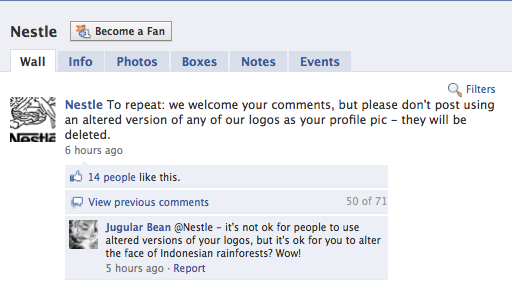
Try to respond to all customer questions and comments and facilitate conversation but remember you can’t change what they think. We only have to go back a year to Nestlé’s palm oil social media debacle to see why.
Keep messages clear and concise – shorter posts have a higher engagement rate. Words like “winner”, “win”, “event”, “special”, and “offer” will resonate well if running a promotion. Requests to “like”, “post”, “comment”, or “tell” us something improve our chances of engagement.
Snapshot of the best
Coca-cola runs innovative promotions and fun, interactive features and has been great at encouraging its 33+ million fans to leave comments, photos and videos on its page.
When a non-fan lands on Red Bull’s page, they’re encouraged to “Like” it with an attention-grabbing image straight away. The team behind the page is extremely in tune with Red Bull’s target audience and creates custom apps and unique content.
Competitions and games are a great way to engage fans and Skittles does this well. “Fame the Rainbow”, which puts a fans face as the profile pic for a week, does this well and is consistent with the brand.
Creating a Facebook fan page for your business is simple, but getting it well established with customers takes time and planning. You can’t expect to have a huge following overnight. Content is key – be creative and interesting and make it easy to share or participate in.
Share this post:
https://ignitepr.com.au/wp-content/uploads/2013/10/Ignite-WebLogo011.png00igniteprhttps://ignitepr.com.au/wp-content/uploads/2013/10/Ignite-WebLogo011.pngignitepr2011-08-26 14:14:192013-12-26 00:01:36Adding value to your brand through Facebook
The latest issue of our newsletter, Ignition, is out now. You can read it here. Email courtney@ignitepr.com.au if you want to be added to our mailing list.
https://ignitepr.com.au/wp-content/uploads/2013/10/Ignite-WebLogo011.png00igniteprhttps://ignitepr.com.au/wp-content/uploads/2013/10/Ignite-WebLogo011.pngignitepr2011-07-08 09:31:342013-12-26 00:01:37New edition of ‘Ignition’ out now
Welcome to the second edition of our regular feature talking to our clients to find out about their experiences of business, good and bad, and any advice they might have for other business leaders and owners.
Pitch your company and what it does in a sentence: Nanotek (formerly ecowash mobile) is the world’s no.1 mobile waterless car washing franchise system. Utilising liquid polymer nanotechnology Nanotek provides unmatched quality and convenience.
How did you get to where you are now? By learning from all our experiences (good and bad) and continually moving not only industry goal posts but our own – we are constantly refining and developing our system (hence the change to Nanotek).
What has been your worst moment in business so far? Before Nanotek as a Marketing Director of a Multinational Organisation, I watched 10 people get retrenched without notice – it made me appreciate the fragility and insecurity of employment and inspired my passion for personal business ownership.
What has been your best moment in business so far? Most recently our launch in Russia, but any time I see one of our mobile units in a new market it is an incredible sensation.
Have you had any business mentors and what did they teach you? My father, who taught me that clear principles and integrity provide the foundation necessary from which to make sustainable decisions.
How does PR help your business/ why is it important to you? PR tells a story – it gives third person insights and perspectives which are beyond the scope of corporate derived advertising. Advertising creates brand awareness, but PR is far more effective in positioning and developing the personality of a brand.
Why do you work with Ignite PR & Marketing? Barrett and Trina are great – very responsive with a thorough understanding of the franchising segment. It is great to be able to confidently outsource such a critical element of our business and know it will be done right.
Share this post:
https://ignitepr.com.au/wp-content/uploads/2013/10/Ignite-WebLogo011.png00igniteprhttps://ignitepr.com.au/wp-content/uploads/2013/10/Ignite-WebLogo011.pngignitepr2011-06-20 09:19:582013-12-26 00:01:55Client close-up: Jim Cornish, Nanotek
When it comes to marketing your business, there are a number of specialist areas that need to be looked at including graphic design, marketing and public relations. Whilst you might be able to do the basics in-house, there is expertise attached to these specialist areas. Here are a few reasons why it’s worth investing in your PR rather than DIY-ing it:
1) We’ve got years of experience and expertise: chances are we’ve done it all before, we’ve written the press releases, we’ve done the media training, we’ve spoken to the journalists, we’ve pitched the stories – we’re doing the job day in, day out, for a varied client list.
2) We can bring something new to the table: coming from an outside perspective we can put forward new ideas, different ways of doing things and challenge the way you do things ‘just because’. We’re there to make your business grow so we can grow too.
3) You can get results without another ‘mouth to feed’: the breadth of our experience means that we are often more cost-effective than it would be to get the person/ people necessary in-house to cover all the tasks we can undertake.
4) We can react fast: if something needs turning around quickly, if you need more hands on deck, an outsourced company should have the extra resource and capability to turn that around for you.
5) We can help upskill your team: working closely side-by-side should mean that your in-house team learns more and more about PR and what it can achieve for your business.
Outsourcing is an investment and it’s important to weigh up the pros and cons before taking that step otherwise you may end up resenting the company that is working for you, rather than using them to their maximum potential and allowing them to work with you and integrate with your team.
The best time to get in the PR experts is if you’re running out of ideas, if you don’t want to make a long-term commitment initially and dip your toe in the water, if your in-house marketing team is overworked, if your head office and marketing function is overseas, if you’re a start-up business and focussed on the core business, if you want to inject fresh ideas and new skills.
But if you choose to go down the path of outsourcing you must be very clear about the objectives and how you will measure success, i.e. what the desired outcome is. It’s important for you to meet the team who would be working on your ‘account’ – you should get on with them and they should have the enthusiasm and skills necessary to deliver.
The best PR agency-client relationships are partnerships where the business is open and honest with the PR consultancy – being up front about business objectives, praising good work, working alongside the agency team and keeping them informed of everything happening in your business.
Share this post:
https://ignitepr.com.au/wp-content/uploads/2013/10/Ignite-WebLogo011.png00igniteprhttps://ignitepr.com.au/wp-content/uploads/2013/10/Ignite-WebLogo011.pngignitepr2011-06-16 10:53:032013-12-26 00:01:55Why businesses should consider outsourcing PR