Tag Archive for: Barrett Gibson

Adding value to your brand through Facebook

Just this month Commonwealth Bank became one of the first Australian banks to start using location-based marketing through Facebook giving away a year’s worth of free movie tickets to anyone who opened an account with the bank after “checking in”. The offer was available to the first 2,200 customers and expired within weeks.

Gone are the days of broadcasting through Facebook – raving about new products, pushing news stories. Just as our friends don’t care when we boast, we’ve come to realise our Facebook fans don’t either.

Facebook has developed into an important communication tool for businesses and the better we understand its fundaments the better we can utilise it.

The opportunity Facebook presents to connect with our customers is enormous. With just the click of a button we can engage a new audience and interact with existing customers in new and exciting ways.

But with the amount of posts generated each day we need to produce engaging content to be noticed. We need to use Facebook as added value to have consumers create a connection with the brand – customers won’t react if we don’t excite them. We need to be fun, creative and respond to their needs.

Here are some things that show you’re doing it right:

Content is key. Build a resource, be creative

Think about what your customers are interesting in. We should be offering our customers something extra that they can’t get elsewhere.

Creating a resource is a great way for customers to engage with our brands – providing information and tips on how to use our products and services, for example. Understanding that small business owners buy computers Dell created a social media resource so small business owners interested in social media keep Dell top of mind.

Give fans teasers in the lead up to a product launch, exclusive information or a sneak peek. We’re not all good writers so be fun and creative. Use engaging materials like video blogs, photos and interesting links. Offer contests and coupons exclusively to Facebook users.

Two-way communication

Invoke responses by asking questions (questions at the end of posts are likely to generate a better response). Utilise the opportunity to listen and interact with customers. Listen and learn about your product, how customers use it and how it’s perceived.

Try to respond to all customer questions and comments and facilitate conversation but remember you can’t change what they think. We only have to go back a year to Nestlé’s palm oil social media debacle to see why.
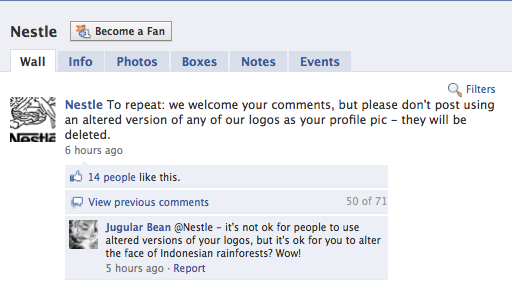
 

Source: http://socialmediainfluence.com/wp-content/uploads/2010/03/jpg-Nestle-Facebook.jpg

Fun and casual tone to match the medium

Keep messages clear and concise – shorter posts have a higher engagement rate. Words like “winner”, “win”, “event”, “special”, and “offer” will resonate well if running a promotion. Requests to “like”, “post”, “comment”, or “tell” us something improve our chances of engagement.

Snapshot of the best

Coca-cola  runs innovative promotions and fun, interactive features and has been great at encouraging its 33+ million fans to leave comments, photos and videos on its page.

When a non-fan lands on Red Bull’s page, they’re encouraged to “Like” it with an attention-grabbing image straight away. The team behind the page is extremely in tune with Red Bull’s target audience and creates custom apps and unique content.

Competitions and games are a great way to engage fans and Skittles does this well.  “Fame the Rainbow”, which puts a fans face as the profile pic for a week, does this well and is consistent with the brand. 

Creating a Facebook fan page for your business is simple, but getting it well established with customers takes time and planning. You can’t expect to have a huge following overnight. Content is key – be creative and interesting and make it easy to share or participate in.

Share this post: Add to FaceBookAdd to StumbleUponAdd to Twitter

Media storm of the month – July 2011

We wouldn’t be doing our job if the focus for Media Storm was on anything else but the News of the World “phone hacking” scandal. It has brought to light two interesting topics, one in regards to the impact of international events on Australia and also privacy rights in the media realm.

An event on the other side of the world immediately sparked the question of freedom of press at News Ltd outlets and the need for a healthy debate about rights to privacy down under.

Julia Gillard perhaps missed a good opportunity to state publicly the difference in media culture in Australia to that in the UK and to show goodwill to the Murdoch media, which is often accused of using its clout to oppose government policy, and making a new start.

Having worked in the UK, I would agree our media is somewhat different. A robust media will always be critical of a government but the question here is privacy. Some British newspapers are quite prepared to probe the lives of celebrities if they can get a story that will sell. I don’t think our papers get this carried away.

We have had the odd one slip through though. Lara Bingle, Jess Origliasso and Ruby Rose, Nick Riewoldt – you have to question the lack of public interest in these cases.

The Federal Government has now moved to introduce a legal right to privacy so it seems something is happening. The debate will need to consider our changing media environment with new media, smart phones and other new technologies allowing easy information share.

As for Australia’s media landscape, some seem concerned about the News Ltd stake (70 percent of print media) for whatever reasons. Is the Australian market place big enough for two dominant players? It could be more interesting and bolster the role of media in a democracy.

For those of you who watched ABC’s Media Watch on Monday night (25 July), it concluded by suggesting that with the News Corp. position weakened by the event in the UK it could possibly lead to Murdoch leaving with his newspapers, or at least many of them in Australia.

Perhaps another competitive player would strengthen Australia’s media landscape. Other countries wouldn’t allow 70 percent print media ownership by one party.

Image courtesy of www.telegraph.co.uk

Share this post: Add to FaceBookAdd to StumbleUponAdd to Twitter

Media Storm of the Month – April 2011

We expected more of a ‘foolish’ start to April in the media than Triple M’s attempt at convincing rugby league fans the Logan Leopards would become the NRL’s 17th team. Perhaps, according to some people, the foolishness was saved for Kevin Rudd’s revelation on ABC television program Q&A that suggested his old Labor Party frontbench was opposed to a carbon tax – the same policy now at the forefront of the party’s pledge. The Gold Coast Suns also get a guernsey this month for their remarkable first ever AFL win, which almost outplayed Easter. Thankfully Anzac Day got the commemoration it deserved with marches across the country attracting record crowds.

And what timing it was in the month we pay tribute to our fallen soldiers that the Australian Defence Force Academy faced a heavy media onslaught for its “misogynistic” culture after an 18-year-old female cadet was broadcasted having sex via Skype to six other male cadets. In this month’s Media Storm of the Month let’s have a look at how this situation unfolded in the media.

We all empathised on April 5 when we read about the girl identified as ‘Kate’ who said “my whole world came crashing down around me” and she was “physically ill” when she found out what had happened. As one journalist wrote however, stories about the ADF are “heroes or villains”, and ADFA commandant Bruce Kafer was the first villain.

Soon after the incident came to light, Kate attended a poorly-timed disciplinary hearing for unrelated offences and Kafer was described by Defence Minister Stephen Smith as being “insensitive” over the matter. Some media protected Kate whilst others said she was not of the “doe-eyed” kind. There were even reports she was “forced to apologise to fellow cadets” for speaking out.

Kate was sent away on compassionate leave while the seven boys continued studying. Under growing pressure from a community desperate for answers, Smith announced six inquiries including a review into the treatment of women within the Australian Defence Force. Major newspapers reported headlines like “Smith ‘in stand-off’ with top brass”.

The media’s focus turned to the culture within the ADF and, in particular, its attitude toward women. If a news story didn’t mention “misogynistic” or “homophobic” it wasn’t on the money.

Is this behaviour unique to the defence force or does an episode like this just reflect a wider societal issue? The media compared it to sex texting and other scandals in the NRL and AFL, but should we be comparing the ADF to footballers? It would probably be fair to say the community demands greater discipline from our nation’s defence force, especially in this instance when a young woman was, effectively, assaulted.

It has been interesting watching this event unfold in the media – from the initial revelations, to the advancing behind-the-scenes dramas – and it’s certainly a good illustration of the hero and villain recipe the media thrives on.

In the wake of the media hype Smith has re-focused the story to take in the debate on women fighting in the frontline by announcing plans to open up frontline military roles for female soldiers. It’s a great opportunity to have a proper debate about this.