Tag Archive for: public relations

PR VS ADVERTISING: An Apple vs An Orange

Advertising and Public Relations (PR) professionals are constantly battling it out to prove their worth in the business world. There has always been an unspoken (or blatantly obvious?) rivalry between the two industries considering, in the past, they were often competing for a portion of a company’s budget. Although this may not be the case nowadays, it is still is a common perception that PR and Advertising are ‘much of a muchness’. This presents an issue for two reasons –

  1. If you, as a Chief Executive Officer, engage either a PR or Advertising agency without understanding what value they can offer your company, you risk being disappointed in the end result (not to mention you will have invested time and money into achieving the wrong goal).
  2. You may be subject to verbal abuse and hostile body language if you liken PR to Advertising in front of a PR practitioner or vice versa (this would be an awkward situation if you deal with this person regularly or if you are in a public setting – or both).

If you would prefer to avoid both of the above undesirable circumstances, I recommend you read on. I’ve listed a few points below outlining the key differences between PR and Advertising to make sure you know your apples from oranges. Keep in mind the points below are just the top of the fruit bowl!

1. Paid space vs Free coverage Advertising is paid placement. This means the company pays to put their ad in a particular space or time slot, whether this be for television, the newspaper or the radio.

PR is all about free media exposure for the company using media releases, events, social media and press conferences (to name a few). An interesting article addressing the effectiveness of PR campaigns (written by CP Communications Director Catriona Pollard) actually highlights that PR can have up to 10 times the impact of traditional, paid advertising!


2.
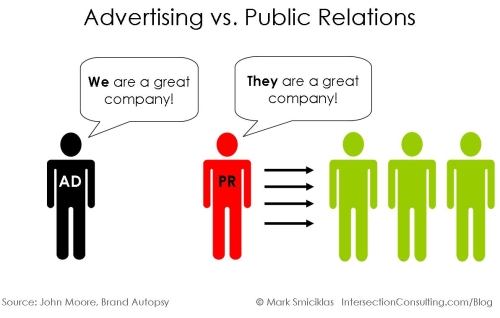
Big Bad Advertising Wolf vs Little Red Riding Hood If we were confronted by Little Red Riding Hood and the Big Bad Wolf on two separate occasions, we would probably believe Little Red’s story over the Wolf’s. Well unfortunately Advertising is the Wolf in this scenario. When consumers see an advertisement, they perceive it to be biased considering the company usually just wants to sell them something. As a result, they are less likely to believe the company (or their product) are as fabulous as they say they are.

PR involves a third party (like a media outlet) albeit endorsing the topic being communicated. In the eyes of the public, this increases the credibility of the information being communicated.
 3. Total  vs No control Considering a company pays precious money for ad space, they are given complete control over the message. They can choose the exact content, the size of the advertisement or the time slot it appears in, the design, and all the other relevant elements.

In PR there is no control over how the media presents the message. Once they have it they can leave it as it is, cut it down, rework it or simply ignore it. They are not obligated to use the information you sent them (EVEN if your email was accompanied by a smiley face emoticon). And this is never more present than with social media and the lack of control over message dissemination.

4. Low vs High priority Don’t look for your ad on the front page of the newspaper because you won’t find it. News takes priority – which pretty much means PR (aka NEWS) trumps advertising any day!

GOT IT?  Now it’s time to get out there, sort the apples from the oranges, and decide which one can offer YOUR business the most value (as a PR practitioner, you all know my answer).

Share this post: Add to FaceBookAdd to StumbleUponAdd to Twitter

A day in the life of a PR professional

While Public Relations is certainly a profession most people know of very little understand what we actually do and what happens day-to-day. A common misconception is that we are always ‘lunching’ and basically having a jolly good time putting on parties. True this is a very simplified and ignorant view of the industry but I have certainly heard it ‘joked’ about on more than one occasion in my career, so today we will take a quick look at a few fundamental things that every practitioner does each day (well at least at Ignite PR & Marketing we do).

1) Plan the day: Time is money so a review of the day ahead, the priorities to conquer and key deadlines to meet that day will ensure the next 8 hours are productive and efficient and maximized for both the client and agency.

2) Media Monitoring: One of the key aspects of our jobs is ensuring we are abreast of current affairs that may influence our clients’ brands or provide great fodder for a story opportunity, so scouring the key news sites, local newspapers, industry blogs and newsletters is an integral part of a good account manager’s job.

3)  Writing , Writing , Writing : No day is complete without a few solid hours of research, interviews and writing covering items like press releases, blogs, newsletters and social media entries to name but a few.

4) Pitch and follow up: Most days time will be spent pitching a story to media with the aim of achieving media coverage to satisfy our clients’ voracious appetites for being ‘seen’ in the market place. Of course it’s all targeted media, so time is spent qualifying the media contacts and ensuring each media receives a story that is relevant to the publication. Sometimes it will work but on the whole a ‘cookie cutter’ approach won’t generate the right results.

5) Client Relations: Clients are our bread and butter so ensuring they feel ‘loved’ is a very important part of a PR professional’s job. Nothing replaces face-to-face communication but given most agencies will work with clients across Australia it is important to be proficient communicators via phone, email and Skype is important. At our agency each manager has multiple clients to work on each day so we have a rule of thumb of a least 3 points of contact a week (if not more).

PR is an exciting and challenging career but there is a considerable amount of time spent behind the desk strategising, writing and working towards helping clients fulfill their communication goals. I’ve never worked in-house but consultancy life is fast paced, challenging, thoroughly enjoyable and satisfying. It’s not a good choice for people who can’t work under pressure but if you hate being bored and like seeing the difference your work can make, PR is a good choice.

6 questions: Jen Bishop, Editor and Publisher, Dynamic Business

Next up in our series finding out how journalists like to work, any issues they have with PRs, how they like stories to be pitched to them, etc, is Jen Bishop, editor and publisher of Dynamic Business, Australia’s highest circulating magazine for SMEs.

1)      What is your deadline day?

I have a different deadline every day of the week! We work on a two-month lead time as a rule, and don’t give out deadlines because if we haven’t commissioned something, why do you need to know?

2)      How do you prefer to be contacted (i.e. email, phone, fax, post)?

Always my email. Press releases by fax or post end up in recycling and I’m so often not at my desk, phone isn’t a good way to get me. I’m usually really quick to reply to emails and tweets/DMs though!

3)      Is there a particular time of day you prefer to be contacted?

Not really.

4)      Do you like to meet companies and bosses for coffee/ lunch? If yes, do you have any favourite venues?

Sometimes. I like venues close to my office so it’s less time out.

5)      What are your three pet peeves about PRs?

One: Chasing up the press release sent half an hour ago.

Two: Not doing your research and getting my name wrong/knowing nothing about the magazine.

Three: Phoning up and reading off a script (usually the intern).

6)      What would the perfect story pitch be for you? And what’s the best PR pitch you have ever had?

The best pitches are those targeted specifically to my publication by someone who has taken the time to look at it.

I get the best pitches from Caroline and Melissa Shawyer from the PR Group because they know exactly what I need and want and they make my life easier by thoroughly thinking something out before they pick up the phone.

Share this post: Add to FaceBookAdd to StumbleUponAdd to Twitter

6 questions: Cayla Dengate, Features Editor, mX

Next up in our series finding out how journalists like to work, any issues they have with PRs, how they like stories to be pitched to them, etc, is Cayla Dengate, features editor of free newspaper mX.

1)      What is your deadline day?

We write mX News early each morning to be ready on the street by 2.30pm, so our news deadline is about 9am Monday to Friday; however features are arranged weeks earlier. Ideally, we want to know about an event two weeks in advance.

2)      How do you prefer to be contacted (i.e. email, phone, fax, post)?

I like to get to know contacts in Brisbane, so a phone call is always appreciated, but email is the failsafe.

3)      Is there a particular time of day you prefer to be contacted?

I’m in the office 6.30am-2.30pm Monday to Wednesday.

4)      Do you like to meet companies and bosses for coffee/ lunch? If yes, do you have any favourite venues?

I find the best way to meet contacts is at launches and openings. That way, I can meet PRs in their element and hopefully get some story ideas in the process.

5)      What are your three pet peeves about PRs?

One: Mobile contact – unless it’s genuinely urgent, I’d prefer work messages to stay on my work phone.

Two: Calling the day of an event – by that stage, it’s mostly too late for mX.

Three: Forced familiarity – it’s not expected for a PR to know everything about every journalist they contact, and it can be embarrassing when they pretend to.

Having said that, I mostly love working with the PR community. Quite a few PRs have helped out mX with last-minute photo requests and contact information!

6)      What would the perfect story pitch be for you? And what’s the best PR pitch you have ever had?

While I’d like to say the perfect pitch is one that’s baked into a cupcake, that’s not necessary. mX is looking for stories that directly relate to the 18-35 age demographic. Whether it’s a serious issue or a community event, we want to know why young people should be interested. In terms of photos, we are always looking for a brightly coloured shoot with young, spunky people and lots of props and movement.

There have been some very memorable PR pitches – from an offer to find me my Soul Mate (already taken, thanks) to a photo opportunity with live tigers – but my favourites have to be the illustrated invitations that arrive before fashion week each year. They’re tiny pieces of art that I often keep for years to come.

Share this post: Add to FaceBookAdd to StumbleUponAdd to Twitter

Why businesses should consider outsourcing PR

When it comes to marketing your business, there are a number of specialist areas that need to be looked at including graphic design, marketing and public relations. Whilst you might be able to do the basics in-house, there is expertise attached to these specialist areas. Here are a few reasons why it’s worth investing in your PR rather than DIY-ing it:

1)      We’ve got years of experience and expertise: chances are we’ve done it all before, we’ve written the press releases, we’ve done the media training, we’ve spoken to the journalists, we’ve pitched the stories – we’re doing the job day in, day out, for a varied client list.

2)      We can bring something new to the table: coming from an outside perspective we can put forward new ideas, different ways of doing things and challenge the way you do things ‘just because’. We’re there to make your business grow so we can grow too.

3)      You can get results without another ‘mouth to feed’: the breadth of our experience means that we are often more cost-effective than it would be to get the person/ people necessary in-house to cover all the tasks we can undertake.

4)      We can react fast: if something needs turning around quickly, if you need more hands on deck, an outsourced company should have the extra resource and capability to turn that around for you.

5)      We can help upskill your team: working closely side-by-side should mean that your in-house team learns more and more about PR and what it can achieve for your business.

Outsourcing is an investment and it’s important to weigh up the pros and cons before taking that step otherwise you may end up resenting the company that is working for you, rather than using them to their maximum potential and allowing them to work with you and integrate with your team.

The best time to get in the PR experts is if you’re running out of ideas, if you don’t want to make a long-term commitment initially and dip your toe in the water, if your in-house marketing team is overworked, if your head office and marketing function is overseas, if you’re a start-up business and focussed on the core business, if you want to inject fresh ideas and new skills.

But if you choose to go down the path of outsourcing you must be very clear about the objectives and how you will measure success, i.e. what the desired outcome is. It’s important for you to meet the team who would be working on your ‘account’ – you should get on with them and they should have the enthusiasm and skills necessary to deliver.

The best PR agency-client relationships are partnerships where the business is open and honest with the PR consultancy – being up front about business objectives, praising good work, working alongside the agency team and keeping them informed of everything happening in your business.

Share this post: Add to FaceBookAdd to StumbleUponAdd to Twitter

6 questions: Alex Tilbury, Finance reporter, The Courier-Mail

Next up in our series finding out how journalists like to work, any issues they have with PRs, how they like stories to be pitched to them, etc, is Alex Tilbury, finance reporter from The Courier-Mail.

1)      What is your deadline day?

Deadline is normally every day from 4pm onwards. The afternoon news conference finishes around 3:30pm so that is when the section editors know what they want for the next day. The Your Money section is nationally syndicated across all News Ltd tabloids and is normally done and dusted each Wednesday for the following Monday.

2)      How do you prefer to be contacted (i.e. email, phone, fax, post)?

Email is definitely best. I don’t want faxes. I am just dipping my toes into the Twittersphere so even a tweet is good. I check it a few times a day. Follow me @AlexTilbury.

3)      Is there a particular time of day you prefer to be contacted?

Please don’t ring any daily newspaper journo in the late afternoon as it is simply too busy to talk. Mornings are always best to call, if you must. As a rule, news conference starts at the Courier-Mail at 9:30, then 10:30am. We are very keen to hear about video/audio options. If you can package a story for an iPad edition (every day at 5am and 5pm), then that’ll work in your favour too. We have to sell our own stories across all the multi-media platforms.

4)      Do you like to meet companies and bosses for coffee/ lunch? If yes, do you have any favourite venues?

I definitely like to meet up but I prefer people to come to our office at Bowen Hills. I don’t have a lot of time to get out basically.  It’s also very posh in the new newsroom, all renovated and we even have great coffee here.

5)      What are your three pet peeves about PRs?

I am constantly surprised when PRs call and ask if you have run such and such story and it may have run already but many PRs don’t actually read the book! Buy the paper, it’s so fundamental. Not every story gets uploaded online. In fact it is only going to get worse when the content online will eventually be subscriber-only. And, don’t ring me and ask who you should pitch a piece to. Start with the Chief of Staff and then contact journos directly.

6)      What would the perfect story pitch be for you? And what’s the best PR pitch you have ever had?

Case studies really help, especially in business reporting. Find me a happy customer and it’s an easy way for people to relate. We are definitely not a trade magazine, so nothing extremely single product specific. Be aware of what is happening in the news and in terms of data coming out. New car sales data, retail data, building approvals… all these are hooks to a genuine news piece that highlights your car dealer, shop owner or builder. Think a little more ‘newsy’.

Best pitch… still waiting! Every day is different. I think the best PRs are the ones who understand we are all here just to do our jobs, fill the book and find the best angle for our readers.

Share this post: Add to FaceBookAdd to StumbleUponAdd to Twitter

BRW’s five questions to ask a PR firm

Last year, BRW wrote an article about some of the top PR firms in Australia, as part of that article it recommended five questions to ask a PR consultancy before considering appointing them. We thought it would be a useful exercise to give you our answers to those questions.

1)      Have any of your staff worked as journalists?

Yes, our senior account manager is trained as a journalist and spent several years working as a journalist and newsreader in FM radio.

Many of our account managers have journalism or communications qualifications, ensuring they know what makes and how to write a good story. And all our staff are tertiary trained in either journalism or public relations writing.

2)      What is your approach to developing a PR strategy?

We sit down with the prospective client and ask why they think PR is a good idea for their business and try to determine what their underlying business objectives are. These questions are critical because if a client is just interested in launching or promoting a particular product, for example, and looking for instant enquiries / sales, then advertising may be a more effective option for them. However, if the client is looking to increase the brand awareness and reputation of their organisation, this is where PR can be most effective.

The most important question is almost always “Why do you feel your business/ organisation needs PR?” the answer to this question often determines the direction of our strategy.

With a clear idea of their business objectives and expectations, we go back to the Ignite team and open the discussion up for ideas generation on the best strategy mix for the client. Given that we specialise in the franchising industry we may, for example, choose to focus our efforts on a number of different parts of the industry depending on the client needs. These might mean we develop a plan that incorporates activity targeting consumer media (for a retail product), business media (for corporate level exposure) and franchising media (for franchise business development).

The strategy mix depends entirely on the client’s industry and their objectives.

3)      Who would be working on my account?

As a rule our clients have at least two people working on them at all times. This usually consists of a senior manager or director, who handles the contact with the client and more complicated content, while an account manager may handle some of the simple content and background work.

However, all staff within the agency are briefed on the details of all new accounts, so are able to step in quickly to work on content if required.

4)      How do you measure results?

As any good agency should: in a variety of ways.

To start with, if we are talking about straight ‘column centimetres’ PR then it is possible to measure what is called Advertising Value Equivalent. This is good for clients as it gives some measurable numbers from a return on investment point of view, but it also only tells about half of the story and should not be used as the only measure of success.

It’s one thing to achieve a large number of clippings, which add weight to an AVE measurement, but if these clips are ‘off message’ then their value is negligible. We also run qualitative analysis on the key message statements of our clients to make sure they are appearing in the coverage they are receiving.

Finally, we run quarterly client satisfaction surveys to ensure our account management staff are performing at the highest possible level. Our aim is for our clients to feel that they have their own in-house PR and marketing manager and these surveys are the best way for us to ensure that this level of service is always being delivered.

5)      How proactive is your team?

In our client surveys, one of questions relates to ’proactive ideas generation’ and this is a key factor on which staff are selected for the agency. As a boutique agency with smaller staff numbers, it’s vitally important that everyone in our team is able to think on their feet and come up with creative, out-of-the-box ideas, not only for addressing client needs, but also to harness opportunities, especially in the media arena, which may not be immediately obvious to the client themselves.

6 questions: Krystal Manson, Drive journalist and newsreader, 101.9 Fox FM

Next up in our series finding out how journalists like to work, any issues they have with PRs, how they like stories to be pitched to them, etc, is Krystal Manson, Drive journalist and newsreader from 101.9 Fox FM in Melbourne.

1)      What are your deadlines throughout the day?

3.30pm, 4.30pm and 5.30pm for bulletins at 4, 5 and 6pm.

2)      How do you prefer to be contacted (i.e. email, phone, fax, post)?

Email is best.

3)      Is there a particular time of day you prefer to be contacted?

For my particular shift before 3pm; between about midday and 3pm is preferred.

4)      Do you like to meet companies and bosses for coffee/ lunch? If yes, do you have any favourite venues?

No. There’s no time for that really in radio. 

5)      What are your three pet peeves about PRs?

One: PR people that call right in the middle of a reading shift or close to news time (6-9am and 4-6pm).

Two: Sending out a release then not having the talent ready to go.

Three: Really looooong phone pitches without taking a breath to let us say NO THANKS!

Also, please don’t ask me what questions I’m going to ask or for a copy of what went to air.

6)      What would the perfect story pitch be for you? And what’s the best PR pitch you have ever had?

The best story pitches are the ones with the best stories. Don’t waste my time if what you are trying to sell isn’t timely (in the news at the time) or meaty (have some research to back up what you’re saying).  I can’t say that I’ve had any amazing pitches, but the ones I usually go for are short, not pushy, and relevant (something I would have likely put a phone call in for anyway).

Share this post: Add to FaceBookAdd to StumbleUponAdd to Twitter

6 questions: Simon Sharwood, Editor, My Business

Next up in our series finding out how journalists like to work, any issues they have with PRs, how they like stories to be pitched to them, etc, is Simon Sharwood, Editor of My Business magazine – the monthly magazine for ambitious business owners.

1)      What is your deadline day?

My Business goes to print on the third Thursday of the month, so I am generally flat out in the week before that date.

We also publish daily online.

I also edit another magazine, Government Technology Review.  It goes to print in the last week of even-numbered months.

2)      How do you prefer to be contacted (i.e. email, phone, fax, post)?

Phone. I keep being told about the importance of conversation to build relationships – and then people send me an email. I like to be called because it’s more effective than email and a lot more personal too.

3)      Is there a particular time of day you prefer to be contacted?

Just call. I’ll either answer or you’ll go to voicemail 😉 But I am a good caller-back, nearly always same day.

4)      Do you like to meet companies and bosses for coffee/ lunch? If yes, do you have any favourite venues?

Yes. I’m honestly happy to meet over a plate of vegemite sandwiches, because I value information more than I value hospitality. If you’ve got a good story to tell, I’m far happier to hear it at a bus-stop than I am waiting for a meal to arrive at a posh restaurant. Please don’t think I’m churlish about hospitality: I just prefer rapid exchange of ideas no matter what environment it takes place in. And I don’t have the time for long lunches or stunts that involve hovercraft rides.

I prefer to do things in and around North Sydney, where our office is located. Travel time is a killer. The Local Café is as good as any. And To’s Malaysian [3/181 Miller Street, North Sydney NSW 2060, (02) 9955 2088] makes the best Har Mee soup this side of KL.

5)      What are your three pet peeves about PRs?

One: PRs who pitch without ever having read publications I work on and therefore make nonsensical, time-wasting, pitches.

Two: Emails that aren’t personalized, or that are forwarded. Even Spam manages to name me, so emails that start “Hi” or “Dear Journalist” are less professional than Spam!

Three: Being invited to events later than other media. This often happens when PRs cannot get a decent turn-up at an event, so they turn to their B-list in the hope of getting enough people in the room to impress the client. Journos know when this happens: we’re pretty well networked people.

6)      What would the perfect story pitch be for you? And what’s the best PR pitch you have ever had?

A perfect pitch would tell a story that I’ve never heard before, one that is full of surprises and interesting people who generously share experiences that my readers will find interesting and so educational they cannot imagine why no-one has ever told them about this before.

I’m yet to get the best pitch ever.

Share this post: Add to FaceBookAdd to StumbleUponAdd to Twitter

How to pitch to journalists

Public relations certainly isn’t all about media relations, but it is a major element. Knowing how to pitch stories and how to build relationships with journalists is a crucial part of our success.

One thing to think about is whether to pitch by phone or email. This can come down to personal preference, the nature of the story, how well you know the journalist you’re pitching to, the time of day. It’s not a broad brush approach, so think about this for every pitch you make. Journalists are more and more favouring email over phone calls, which can disrupt their day much more. Also, in this modern age of social media consider using services such as Twitter to pitch. There’s certainly skill in pitching a story in 140 characters and it’s direct and much more immediate.

Here are some other key things to bear in mind.

1)      Know your story: this may sound obvious, but can you sum your story up in two or three sentences or a few bullet points?

2)      Make it relevant: why should a particular journalist care about what you have to say? Even if you’re working from a news release that has been approved by the client you can vary the pitch and pick out different elements according to who you’re talking to. And don’t forget about the ‘extras’, e.g. interviews, exclusive additional content, photos, etc. Be targeted

3)      Do your research: use media databases such as MEDIAtlas (paid-for) and  MediaSync (free) to find contact details and the right contacts, but also try to look at a publication or website, listen to a radio station or watch a particular television show – know who covers what, what’s been covered on your topic recently and whether a particular journalist always wants exclusives

4)      Respect deadlines: if you’re calling a journalist always check whether it’s a good time to talk, you don’t want to launch straight into a pitch if they’re on a deadline; it won’t be appreciated

5)      Get to the point: even if a journalist says it is a good time to talk, make sure you get to the point (this links back to knowing your story) – they haven’t got all day; some journalists will receive many calls and hundreds of emails a day

6)      Be professional: be friendly but don’t be over-pally if it’s the first time you’ve spoken to someone. With the first contact you have no credibility and no history, so it will take time to establish this

7)      Don’t spam: similarly, consider whether a story really is relevant to someone, if you’ve made a media list using something like MEDIAtlas make sure there aren’t duplicates in the list so you don’t call or email someone more than once

8)      Be available: if you’re pitching a story make sure you’re around and ready to deal with any requests or follow ups from journalists otherwise you could miss out

9)      Follow up with caution: if you’ve sent an email pitch, don’t just follow it with a call saying “did you get my email?”, consider whether you can offer anything else – what justifies your follow up call? Perhaps in your email you can say “I’ll call in a day or two to get your feedback, unless I hear from you beforehand” – at least then you’ve given a warning!

10)   Know when to give up: sometimes a story is perfect for someone, and you know it, so you keep trying, but sometimes you will be flogging a dead horse of a story so you need to know when to call it quits. If your  story isn’t flying, think about why and what you can do to change this in the future, it’s our job as PRs to advise our clients of the best course of action after all

If you’re planning a long and illustrious career in the PR industry it’s vital to understand how the media works and how to work with the media. Think long-term relationships and making friends. If you do a journalist a favour, turn around stories quickly and efficiently, pitch the right things to the right people, you’ll make a good name for yourself and journalists will, in turn, listen to you.

What do you think? Are you a PR with a journalist pitch story to tell? Are you a journalist with strong opinions about how PRs pitch stories to you (this is most of you, surely?!)? Do you have anything to add to this? We’d love to hear from anyone with advice or anecdotes.

Share this post: Add to FaceBookAdd to StumbleUponAdd to Twitter