Writing a great award submission

Last year, our client Mr Rental won the title of ‘Franchisor of the Year’ at the 2010 FCA (Franchise Council of Australia) Excellence in Franchising Awards. The PR potential from winning an award is huge and in light of the FCA awards that happened this week, we thought we’d share some advice on why you should be thinking about entering your company in business awards, and provide tips on how to prepare a good award submission.

Why would my company want to win a business award? What are the benefits?

We always encourage clients to enter business awards because of the opportunity they have to receive great recognition. It gives you fantastic PR and media opportunities both within your respective industry and through broader media channels, which allows you to reach a wider audience. Business awards highlight industry leaders, reveal innovative processes and products and ultimately attract new clients and customers to your business. An award win also boosts company morale and attracts top talent.

Where do I find awards opportunities?

The nature of your business will determine the categories and types of awards you should be entering. Your industry’s governing body is usually a good place to start for industry specific awards. Some major national business awards we encourage our clients to enter each year are BRW Fast Franchises, BRW ANZ Private Business Awards, Premier’s Sustainability Awards (VIC), Westpac New Zealand Franchise Awards and the FCA Excellence in Franchising Awards. Businesses can also find awards at a local level through council websites and the local chamber of commerce.

How to prepare an award-winning award submission

1. Read and understand award criteria. Criteria are a guideline to help you structure your award submission and a standard by which judges compare different entries. It is therefore crucial to understand them. Different sections are usually weighted differently and it is important to understand the areas requiring greater attention. Information seminars are often held to explain the marking criteria and offer tips and advice on completing the award. Understanding the criteria and submission requirements as soon as possible will ensure you have ample time to manage its completion.

2. Prepare brief responses to award questions. Once you are familiar with the criteria, go through the questions and requirements and jot down brief answers ensuring you address key points of the question reflecting your company’s key strengths and points of difference. After this, you should have a good understanding of the layout of your submission and what supporting information will be required.

3. Prepare supporting information. Anything you mention in your submission about company performance should be supported with evidence where possible. Things like sales performance, customer growth, brand awareness etc should all be supported with graphs and figures. This section usually calls upon specialties of other team members (ie operations, marketing) so it is important the award writer gives them enough time to gather such information.

4. Begin writing draft submission. Now that you have good outline of what you will write and supporting information on its way it’s time to start fleshing out the first draft of your award submission. Address each point of the question in limited detail without waffling on or exceeding word limit. Always remember the weight each question or section bears in relation to the overall criteria. Leave all references to supporting information as “Appendix blank” as this is something likely to change before the final version. Make sure the key information is included in the answer and the award reader doesn’t have to refer to an appendix for this.

5. Editing. Make sure the wording used in your submission is consistent, flows nicely and is easy for the reader to understand. Check for word economy and where sentences can be shortened. Ensure word limit isn’t exceeded for each section responses address questions properly. You can now reference any responses requiring supporting information ensuring all graphs, statistics etc are labelled and clear. Again, ensure your company’s strengths and points of difference are still highlighted as sometimes they can be lost in editing. Ensure anyone who has contributed information to the submission is satisfied it has been used accurately. Hand the submission over to a colleague to proof read before sending it to your General Manager or CEO to ensure it is aligned with the company’s overall mission and objectives.

6. Design, formatting and submission. When your submission is ready to be designed to your company’s branding standards, ensure it reflects the award’s formatting requirements. Make sure all graphs and appendices are displayed correctly as sometimes this changes when reformatted. Ensure all required documents like criteria sheet or front page are included. Give the award one final proof before printing, binding and submitting via the correct methods.

Key features of a great submission

1. Eye-catching and easy to read

2. Clear profile of your company and its core offering

3. Clear responses meeting key requirements of questions

4. Clear and appealing graphs and illustrations

5. Great supporting evidence to explain responses

The more time you put into an award submission, the better it will be. Leaving an award until the last minute will mean you’re not giving it its full potential to reflect your organisation. Using each team member to provide information on their function allows the true strengths of your business to be known.

Keep an eye out for upcoming award opportunities as it might just be your time to shine.

Share this post: Add to FaceBookAdd to StumbleUponAdd to Twitter

Adding value to your brand through Facebook

Just this month Commonwealth Bank became one of the first Australian banks to start using location-based marketing through Facebook giving away a year’s worth of free movie tickets to anyone who opened an account with the bank after “checking in”. The offer was available to the first 2,200 customers and expired within weeks.

Gone are the days of broadcasting through Facebook – raving about new products, pushing news stories. Just as our friends don’t care when we boast, we’ve come to realise our Facebook fans don’t either.

Facebook has developed into an important communication tool for businesses and the better we understand its fundaments the better we can utilise it.

The opportunity Facebook presents to connect with our customers is enormous. With just the click of a button we can engage a new audience and interact with existing customers in new and exciting ways.

But with the amount of posts generated each day we need to produce engaging content to be noticed. We need to use Facebook as added value to have consumers create a connection with the brand – customers won’t react if we don’t excite them. We need to be fun, creative and respond to their needs.

Here are some things that show you’re doing it right:

Content is key. Build a resource, be creative

Think about what your customers are interesting in. We should be offering our customers something extra that they can’t get elsewhere.

Creating a resource is a great way for customers to engage with our brands – providing information and tips on how to use our products and services, for example. Understanding that small business owners buy computers Dell created a social media resource so small business owners interested in social media keep Dell top of mind.

Give fans teasers in the lead up to a product launch, exclusive information or a sneak peek. We’re not all good writers so be fun and creative. Use engaging materials like video blogs, photos and interesting links. Offer contests and coupons exclusively to Facebook users.

Two-way communication

Invoke responses by asking questions (questions at the end of posts are likely to generate a better response). Utilise the opportunity to listen and interact with customers. Listen and learn about your product, how customers use it and how it’s perceived.

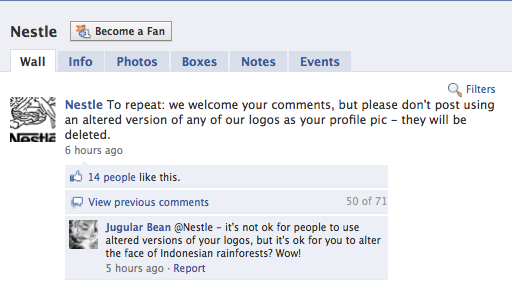
Try to respond to all customer questions and comments and facilitate conversation but remember you can’t change what they think. We only have to go back a year to Nestlé’s palm oil social media debacle to see why.


Source: http://socialmediainfluence.com/wp-content/uploads/2010/03/jpg-Nestle-Facebook.jpg

Fun and casual tone to match the medium

Keep messages clear and concise – shorter posts have a higher engagement rate. Words like “winner”, “win”, “event”, “special”, and “offer” will resonate well if running a promotion. Requests to “like”, “post”, “comment”, or “tell” us something improve our chances of engagement.

Snapshot of the best

Coca-cola  runs innovative promotions and fun, interactive features and has been great at encouraging its 33+ million fans to leave comments, photos and videos on its page.

When a non-fan lands on Red Bull’s page, they’re encouraged to “Like” it with an attention-grabbing image straight away. The team behind the page is extremely in tune with Red Bull’s target audience and creates custom apps and unique content.

Competitions and games are a great way to engage fans and Skittles does this well.  “Fame the Rainbow”, which puts a fans face as the profile pic for a week, does this well and is consistent with the brand. 

Creating a Facebook fan page for your business is simple, but getting it well established with customers takes time and planning. You can’t expect to have a huge following overnight. Content is key – be creative and interesting and make it easy to share or participate in.

Share this post: Add to FaceBookAdd to StumbleUponAdd to Twitter

The Power of WOM

Word of mouth (or WOM) is one of those true marketing mysteries.

It’s also a topic that can easily bamboozle business owners into believing it can only be doled out by highly paid WOM gurus (closely related to social media gurus) and that the ensuing buzz will be a magic bullet to business success.

So what is WOM-marketing and how can you cut through the hype and use it drive your business?

To get started let’s get some WOM marketing buzzwords out of the way. Word of mouth marketing encompasses a variety of subcategories including buzz, blog, viral, grassroots, brand advocates, cause influencers social media marketing and ambassador programs to name but a few.

Ultimately all of the above concepts hinge on the idea that the personal nature of the communications between people is more credible than advertising and that people are therefore more likely to apply information received via word of mouth.

Think about the last time someone recommended a great restaurant to you and you tried it out based on that recommendation. That communication and subsequent action is one complete word of mouth transaction.

These referrals are given to us, and handed out by us, almost subconsciously all the time.

Here’s the kicker though – the success or failure of word-of-mouth marketing depends on two crucial factors:

1. The extent of customer satisfaction with the product or service, and

2. The perceived value of the product or service

Below are two case studies covering the largest and the smallest ends of the business spectrum, followed by some important questions to ask yourself before jumping into the wonderful world of WOM.

1.     Amazon.com 

In 2003 online retail giant Amazon scrapped its television  advertising strategy (US $100M) and used the money it saved to invest in its now famous free shipping policy (purchases over $25 are eligible for free shipping anywhere in the world).

Amazon still loses money on shipping, but this is more than made up for by the incredible word of mouth support generated by the decision.

Amazon also spent a great deal of money ensuring they had an unbeatable range of stock, including over one million books, many of which are not best sellers, simply to ensure customers can always find what they are looking for.

Further, when Amazon launched its Kindle E-Reader it relied on word of mouth marketing in order to sell units. The website invested in its “See a Kindle in your area” message board where customers interested in purchasing could locate existing Kindle owners in their area, meet with them, and try out the product for themselves.

Today Amazon is the world’s largest online retailer and is expected to announce $9.37 billion in revenue this quarter.

2.     Chompers

But it’s not just the big end of town getting in on the WOM act. This month local Brisbane independent fast food outlet ‘Chompers’ launched its OMG Double Double Burger: Two meat patties, two slices of cheese, bacon and lettuce, and two Krispy Kreme doughnuts instead of burger buns.

Chompers Owner Chris Bowe admits the burger was created for the sole purpose of generating WOM interest.

‘‘At first, we aimed to get attention via social media including Facebook,’’ he said.

‘‘We had people come in and take photos of it on their mobile phones and that’s how word spread initially.

‘‘We obviously don’t have the marketing budget of a bigger chain … and people always want to try something different.’’

So size is no barrier to successful WOM marketing. But before you start masterminding your own 6000 calorie burger, ask yourself these five word of mouth questions – and good luck!

1. Are you doing something dramatically different in your market or do you have a truly original product? For Amazon it’s a service: free shipping. For Chompers it’s a product: the OMG Double Double Burger

2. Does your product or service appeal to a relatively wide audience (are you WOM-able)? Amazon and Chompers are general consumer businesses. If you’re business is niche or business-to-business WOM may not the most effective option

3. Is your customer service and delivery experience top shelf? If Amazon’s products did not arrive on time or in perfect condition all of their hard WOM work would be undone. The Chompers’ burger must be tasty as well as attention grabbing.

4. Are you ready to WOM? If Amazon did not have the capacity to deliver, or if Chompers ran out of Krispy Krème donuts every time someone asked for the burger, their WOM could easily turn negative. You need the capacity to deliver on your WOM promises.

5. Do you have a plan beyond WOM? Like all marketing, WOM should be part of broader strategy. It is not a marketing plan on its own, but as seen in the case studies, WOM can be a powerful and cost effective tool in your marketing arsenal.

Images courtesy of www.chompers.com.au and www.amazon.com

Share this post: Add to FaceBookAdd to StumbleUponAdd to Twitter