Brainstorms

Two brains are better than one: The benefits of brainstorming

Public relations is an industry in which professionals must constantly develop creative solutions to problems, generate clever ideas to increase brand awareness and find a way to make a brand newsworthy when in reality there may be nothing new happening at all.

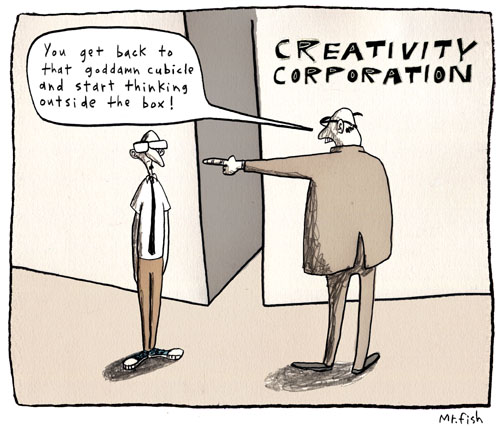
This is where brainstorming steps in to make the impossible, possible. Brainstorming is where a group of people bounce ideas off one another in order to foster creativity and generate solutions to a problem. There are only so many times one person can pull new ideas out of nowhere and that is why brainstorming is such an effective tool in public relations.

The main aim of brainstorming is to build on and extend others’ ideas. It is quite common for a number of ideas to be rolled into one. It’s not about one person coming up with the best idea.

In order to get the most out of an idea generation session consider the following tips next time you sit down for a brainstorm.

  1. Know what you want to achieve- have a goal or outcome that you want to achieve from the creative thinking session.
  2. Set a time limit.
  3. Conduct the brainstorm in a calm and friendly environment.
  4. Have one person record the ideas on writing materials that can be seen by all such as whiteboards or easels.
  5. Create a relaxed space that fosters creativity and playfulness. Provide things such as food, comfortable chairs or a talking stick or object (a ball is easy to get around a room).
  6. Focus on quantity of ideas.
  7. Have people brainstorm individually before the creative thinking session then come together and build on these ideas as a group.
  8. Refrain from judging and/or criticizing others’ ideas.
  9. Only sort through and narrow ideas at the end of the session.
  10. Encourage creativity. It’s equally as important for participants to come up with reasonable, valid suggestions as it is for them to generate crazy and outlandish ideas- sometimes what may seem like a wild idea at first is actually a great solution to the problem.

There are also patterns that arise in creative thinking sessions that hinder the process so make sure to look out for the following during your next brainstorm.

AVOID :  groupthink

  • “Groupthink” occurs when a team of individuals settle on a single idea rather than continuing to generate new ideas as the single idea was accepted by the group as a good solution. This act boils down to a person’s desire to be socially accepted by their peers. Individuals would rather agree with something they don’t whole heartedly believe in than risk exclusion by challenging an idea.

AVOID :  social loafing

  • Social loafing can be explained like this: put one person in a room by themselves and give them a task with a deadline. Then put two people in a room and give them the same task and deadline. Who will be more productive? The team or the individual? Social loafing is when individuals put less effort into a task due to working in a team.

SOLUTION: mind mapping

  • Mind mapping allows for ideas to be generated individually before the group comes together to brainstorm. It involves writing down a word or phrase and getting each person to build on the original theme and map out their thought process. Everyone then brings their mind map to the group brainstorm and after all the ideas have been shared, the team can evaluate as a whole. This reduces the risk of groupthink and social loafing.

Check out some other great articles on brainstorming :

http://www.businessweek.com/innovate/content/jul2006/id20060726_517774.htm
Adding value to your brand through Facebook

Just this month Commonwealth Bank became one of the first Australian banks to start using location-based marketing through Facebook giving away a year’s worth of free movie tickets to anyone who opened an account with the bank after “checking in”. The offer was available to the first 2,200 customers and expired within weeks.

Gone are the days of broadcasting through Facebook – raving about new products, pushing news stories. Just as our friends don’t care when we boast, we’ve come to realise our Facebook fans don’t either.

Facebook has developed into an important communication tool for businesses and the better we understand its fundaments the better we can utilise it.

The opportunity Facebook presents to connect with our customers is enormous. With just the click of a button we can engage a new audience and interact with existing customers in new and exciting ways.

But with the amount of posts generated each day we need to produce engaging content to be noticed. We need to use Facebook as added value to have consumers create a connection with the brand – customers won’t react if we don’t excite them. We need to be fun, creative and respond to their needs.

Here are some things that show you’re doing it right:

Content is key. Build a resource, be creative

Think about what your customers are interesting in. We should be offering our customers something extra that they can’t get elsewhere.

Creating a resource is a great way for customers to engage with our brands – providing information and tips on how to use our products and services, for example. Understanding that small business owners buy computers Dell created a social media resource so small business owners interested in social media keep Dell top of mind.

Give fans teasers in the lead up to a product launch, exclusive information or a sneak peek. We’re not all good writers so be fun and creative. Use engaging materials like video blogs, photos and interesting links. Offer contests and coupons exclusively to Facebook users.

Two-way communication

Invoke responses by asking questions (questions at the end of posts are likely to generate a better response). Utilise the opportunity to listen and interact with customers. Listen and learn about your product, how customers use it and how it’s perceived.

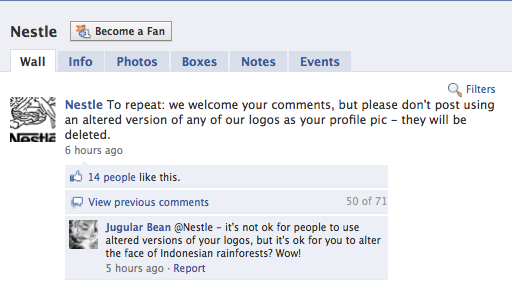
Try to respond to all customer questions and comments and facilitate conversation but remember you can’t change what they think. We only have to go back a year to Nestlé’s palm oil social media debacle to see why.


Source: http://socialmediainfluence.com/wp-content/uploads/2010/03/jpg-Nestle-Facebook.jpg

Fun and casual tone to match the medium

Keep messages clear and concise – shorter posts have a higher engagement rate. Words like “winner”, “win”, “event”, “special”, and “offer” will resonate well if running a promotion. Requests to “like”, “post”, “comment”, or “tell” us something improve our chances of engagement.

Snapshot of the best

Coca-cola  runs innovative promotions and fun, interactive features and has been great at encouraging its 33+ million fans to leave comments, photos and videos on its page.

When a non-fan lands on Red Bull’s page, they’re encouraged to “Like” it with an attention-grabbing image straight away. The team behind the page is extremely in tune with Red Bull’s target audience and creates custom apps and unique content.

Competitions and games are a great way to engage fans and Skittles does this well.  “Fame the Rainbow”, which puts a fans face as the profile pic for a week, does this well and is consistent with the brand. 

Creating a Facebook fan page for your business is simple, but getting it well established with customers takes time and planning. You can’t expect to have a huge following overnight. Content is key – be creative and interesting and make it easy to share or participate in.

Share this post: Add to FaceBookAdd to StumbleUponAdd to Twitter

PR VS ADVERTISING: An Apple vs An Orange

Advertising and Public Relations (PR) professionals are constantly battling it out to prove their worth in the business world. There has always been an unspoken (or blatantly obvious?) rivalry between the two industries considering, in the past, they were often competing for a portion of a company’s budget. Although this may not be the case nowadays, it is still is a common perception that PR and Advertising are ‘much of a muchness’. This presents an issue for two reasons –

  1. If you, as a Chief Executive Officer, engage either a PR or Advertising agency without understanding what value they can offer your company, you risk being disappointed in the end result (not to mention you will have invested time and money into achieving the wrong goal).
  2. You may be subject to verbal abuse and hostile body language if you liken PR to Advertising in front of a PR practitioner or vice versa (this would be an awkward situation if you deal with this person regularly or if you are in a public setting – or both).

If you would prefer to avoid both of the above undesirable circumstances, I recommend you read on. I’ve listed a few points below outlining the key differences between PR and Advertising to make sure you know your apples from oranges. Keep in mind the points below are just the top of the fruit bowl!

1. Paid space vs Free coverage Advertising is paid placement. This means the company pays to put their ad in a particular space or time slot, whether this be for television, the newspaper or the radio.

PR is all about free media exposure for the company using media releases, events, social media and press conferences (to name a few). An interesting article addressing the effectiveness of PR campaigns (written by CP Communications Director Catriona Pollard) actually highlights that PR can have up to 10 times the impact of traditional, paid advertising!


2.
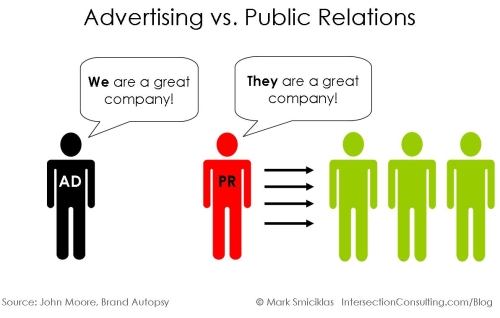
Big Bad Advertising Wolf vs Little Red Riding Hood If we were confronted by Little Red Riding Hood and the Big Bad Wolf on two separate occasions, we would probably believe Little Red’s story over the Wolf’s. Well unfortunately Advertising is the Wolf in this scenario. When consumers see an advertisement, they perceive it to be biased considering the company usually just wants to sell them something. As a result, they are less likely to believe the company (or their product) are as fabulous as they say they are.

PR involves a third party (like a media outlet) albeit endorsing the topic being communicated. In the eyes of the public, this increases the credibility of the information being communicated.

 3. Total  vs No control Considering a company pays precious money for ad space, they are given complete control over the message. They can choose the exact content, the size of the advertisement or the time slot it appears in, the design, and all the other relevant elements.

In PR there is no control over how the media presents the message. Once they have it they can leave it as it is, cut it down, rework it or simply ignore it. They are not obligated to use the information you sent them (EVEN if your email was accompanied by a smiley face emoticon). And this is never more present than with social media and the lack of control over message dissemination.

4. Low vs High priority Don’t look for your ad on the front page of the newspaper because you won’t find it. News takes priority – which pretty much means PR (aka NEWS) trumps advertising any day!

GOT IT?  Now it’s time to get out there, sort the apples from the oranges, and decide which one can offer YOUR business the most value (as a PR practitioner, you all know my answer).

Share this post: Add to FaceBookAdd to StumbleUponAdd to Twitter