New edition of ‘Ignition’ out now

The latest issue of our newsletter, Ignition, is out now. You can read it here. Email courtney@ignitepr.com.au if you want to be added to our mailing list.

The latest issue of our newsletter, Ignition, is out now. You can read it here. Email courtney@ignitepr.com.au if you want to be added to our mailing list.

At presentation skills training it’s always drilled into you that it’s not necessarily what you say, but how you say it. So you could be delivering the most brilliant speech ever, but if it’s done badly – mumbling, monotone, no eye contact, etc – then you may as well be reciting a nursery rhyme for all that your audience will take away from their experience. Perhaps a little extreme, but one aspect of delivery is body language. It’s a key part of how you present yourself, whether it’s in a speech, an interview or presentation. Every eyebrow twitch, hair twirl, eye movement or leg-crossing can indicate something about you.
Whilst we’re certainly not experts on the subject, we’ve done some research to offer you some top tips on understanding body language so that you can hopefully make it work in your favour.
1) First impressions really count. When first meeting people it’s vital to make a good impression – make sure you have a firm (but not too firm) handshake with no sweaty palms; make proper eye contact (but don’t stare); be alert, if sitting down make sure you have a relaxed but upright posture.
2) Learn the art of ‘mirroring’. This is when you pick up gestures and tone from a person and ‘mirror’ what they are doing. When done in a subtle way this is often said to make people feel more comfortable in your presence as it’s often something that occurs between close friends and family members. Don’t be too obvious though as otherwise people might assume that you’re making a mockery of them.
3) Be ‘arm aware’. What are your arms and hands doing? Crossing your arms across your chest can be viewed as defensive, expressing opposition or being insecure; if sitting at a table, folding your hands in your lap or having them under the table can be viewed as untrustworthy; wringing your hands can be seen as a sign of nervousness; and when presenting an idea or talking be wary about being too wild in your gestures.
4) Respect personal space. Never get too close to someone, especially in a workplace situation, unless you know them really well. People can really take offence; it can create nervous tension and create a negative atmosphere.
5) Are you flirting with me? Women especially can have a minefield to manoeuvre round when it comes to body language being interpreted as flirtatious behaviour, for example stroking your neck (nervous) or fiddling with your hair (anxious). Be wary of this, especially when dealing with people of the opposite sex.
Another tip worth noting is for doing presentations and speeches – film yourself practicing and then play it back without any sound. You will notice any nervous ‘tics’ or repetitive actions as well as what works.
Whilst this blog post is our own work, we used a number of articles to inform our words: Forbes.com, Thinkquest.org, New York Business Partners and eHow.com.
Share this post: 


Welcome to the second edition of our regular feature talking to our clients to find out about their experiences of business, good and bad, and any advice they might have for other business leaders and owners.
Name: Jim Cornish
Job title and company: CEO, Nanotek
Pitch your company and what it does in a sentence: Nanotek (formerly ecowash mobile) is the world’s no.1 mobile waterless car washing franchise system. Utilising liquid polymer nanotechnology Nanotek provides unmatched quality and convenience.
How did you get to where you are now? By learning from all our experiences (good and bad) and continually moving not only industry goal posts but our own – we are constantly refining and developing our system (hence the change to Nanotek).
What has been your worst moment in business so far? Before Nanotek as a Marketing Director of a Multinational Organisation, I watched 10 people get retrenched without notice – it made me appreciate the fragility and insecurity of employment and inspired my passion for personal business ownership.
What has been your best moment in business so far? Most recently our launch in Russia, but any time I see one of our mobile units in a new market it is an incredible sensation.
Have you had any business mentors and what did they teach you? My father, who taught me that clear principles and integrity provide the foundation necessary from which to make sustainable decisions.
How does PR help your business/ why is it important to you? PR tells a story – it gives third person insights and perspectives which are beyond the scope of corporate derived advertising. Advertising creates brand awareness, but PR is far more effective in positioning and developing the personality of a brand.
Why do you work with Ignite PR & Marketing? Barrett and Trina are great – very responsive with a thorough understanding of the franchising segment. It is great to be able to confidently outsource such a critical element of our business and know it will be done right.
Share this post:
If you haven’t seen this yet then I defy you not to smile at this child’s words of encouragement to other children who might be trying to learn how to do something new. Thumbs up for rock and roll everyone!
Share this post:

When it comes to marketing your business, there are a number of specialist areas that need to be looked at including graphic design, marketing and public relations. Whilst you might be able to do the basics in-house, there is expertise attached to these specialist areas. Here are a few reasons why it’s worth investing in your PR rather than DIY-ing it:
1) We’ve got years of experience and expertise: chances are we’ve done it all before, we’ve written the press releases, we’ve done the media training, we’ve spoken to the journalists, we’ve pitched the stories – we’re doing the job day in, day out, for a varied client list.
2) We can bring something new to the table: coming from an outside perspective we can put forward new ideas, different ways of doing things and challenge the way you do things ‘just because’. We’re there to make your business grow so we can grow too.
3) You can get results without another ‘mouth to feed’: the breadth of our experience means that we are often more cost-effective than it would be to get the person/ people necessary in-house to cover all the tasks we can undertake.
4) We can react fast: if something needs turning around quickly, if you need more hands on deck, an outsourced company should have the extra resource and capability to turn that around for you.
5) We can help upskill your team: working closely side-by-side should mean that your in-house team learns more and more about PR and what it can achieve for your business.
Outsourcing is an investment and it’s important to weigh up the pros and cons before taking that step otherwise you may end up resenting the company that is working for you, rather than using them to their maximum potential and allowing them to work with you and integrate with your team.
The best time to get in the PR experts is if you’re running out of ideas, if you don’t want to make a long-term commitment initially and dip your toe in the water, if your in-house marketing team is overworked, if your head office and marketing function is overseas, if you’re a start-up business and focussed on the core business, if you want to inject fresh ideas and new skills.
But if you choose to go down the path of outsourcing you must be very clear about the objectives and how you will measure success, i.e. what the desired outcome is. It’s important for you to meet the team who would be working on your ‘account’ – you should get on with them and they should have the enthusiasm and skills necessary to deliver.
The best PR agency-client relationships are partnerships where the business is open and honest with the PR consultancy – being up front about business objectives, praising good work, working alongside the agency team and keeping them informed of everything happening in your business.
Share this post:
Last year, BRW wrote an article about some of the top PR firms in Australia, as part of that article it recommended five questions to ask a PR consultancy before considering appointing them. We thought it would be a useful exercise to give you our answers to those questions.

1) Have any of your staff worked as journalists?
Yes, our senior account manager is trained as a journalist and spent several years working as a journalist and newsreader in FM radio.
Many of our account managers have journalism or communications qualifications, ensuring they know what makes and how to write a good story. And all our staff are tertiary trained in either journalism or public relations writing.
2) What is your approach to developing a PR strategy?
We sit down with the prospective client and ask why they think PR is a good idea for their business and try to determine what their underlying business objectives are. These questions are critical because if a client is just interested in launching or promoting a particular product, for example, and looking for instant enquiries / sales, then advertising may be a more effective option for them. However, if the client is looking to increase the brand awareness and reputation of their organisation, this is where PR can be most effective.
The most important question is almost always “Why do you feel your business/ organisation needs PR?” the answer to this question often determines the direction of our strategy.
With a clear idea of their business objectives and expectations, we go back to the Ignite team and open the discussion up for ideas generation on the best strategy mix for the client. Given that we specialise in the franchising industry we may, for example, choose to focus our efforts on a number of different parts of the industry depending on the client needs. These might mean we develop a plan that incorporates activity targeting consumer media (for a retail product), business media (for corporate level exposure) and franchising media (for franchise business development).
The strategy mix depends entirely on the client’s industry and their objectives.
3) Who would be working on my account?
As a rule our clients have at least two people working on them at all times. This usually consists of a senior manager or director, who handles the contact with the client and more complicated content, while an account manager may handle some of the simple content and background work.
However, all staff within the agency are briefed on the details of all new accounts, so are able to step in quickly to work on content if required.
4) How do you measure results?
As any good agency should: in a variety of ways.
To start with, if we are talking about straight ‘column centimetres’ PR then it is possible to measure what is called Advertising Value Equivalent. This is good for clients as it gives some measurable numbers from a return on investment point of view, but it also only tells about half of the story and should not be used as the only measure of success.
It’s one thing to achieve a large number of clippings, which add weight to an AVE measurement, but if these clips are ‘off message’ then their value is negligible. We also run qualitative analysis on the key message statements of our clients to make sure they are appearing in the coverage they are receiving.
Finally, we run quarterly client satisfaction surveys to ensure our account management staff are performing at the highest possible level. Our aim is for our clients to feel that they have their own in-house PR and marketing manager and these surveys are the best way for us to ensure that this level of service is always being delivered.
5) How proactive is your team?
In our client surveys, one of questions relates to ’proactive ideas generation’ and this is a key factor on which staff are selected for the agency. As a boutique agency with smaller staff numbers, it’s vitally important that everyone in our team is able to think on their feet and come up with creative, out-of-the-box ideas, not only for addressing client needs, but also to harness opportunities, especially in the media arena, which may not be immediately obvious to the client themselves.

By the time you read this, the media phenomenon that is ‘planking’ will have gone the way of Y2K, Napster and Rebecca Black – relegated to the scrapheap of dull irrelevant news from yesteryear.
But if you can cast your mind right back to the beginning of the month, you might recall the social media driven pastime was hitting the news in a big way, especially after the tragic death of an intoxicated Brisbane planker.
Fairfax papers had plenty to say after the incident:
It was a harmless craze just four days ago. Kerri-Anne Kennerley opened her television talk show lying balanced, face-down, on the back of a couch. Karl Stefanovic was lying flat on the Today show desk in front of the cameras.
But early yesterday morning, the ”planking” fad sweeping social networking sites proved fatal. Acton Beale, 20, was positioning himself on a balcony railing seven storeys up in Brisbane when he lost his footing and plunged to his death in the car park below.
Calls to ban the fad came thick and fast. News Limited described the phenomenon as “spreading like a virus around the world” and conservative commentators derided the youth of today and called for reinstated compulsory national service to give Gen Y something constructive to do.
So what gave the planking craze such strong media kudos? Sure 130,000 odd people ‘liked’ the Planking Australia page on Facebook. So what? More than four million people ‘like’ the page for chocolate chip cookies, but you don’t see Karl gorging himself on biscuits on Today, nor do we hear about the “cookie eating plague sweeping the globe”.
The answer comes down to a couple of simple journalistic rules known as news values.
The idea goes that any potential news item can be assessed for newsworthiness based on six or seven key criteria.
These are often defined as impact, timeliness, prominence, proximity, bizarreness, conflict and currency, or some combination of these.
Unfortunately for all of us, planking ticks a couple of these boxes with a big red felt pen.
First is impact. The story ‘grew legs and ran’ after the first death associated with the craze. This was made doubly appetising for media due to two extra factors.
1) The man who died was a young person, i.e. under 30, and;
2) The man who died was under the influence of alcohol at the time (Australia’s binge drinking culture is another hot media topic).
This brings us to the second key media value that planking satisfies perfectly: currency.
The rapid rise of social media has sparked an insatiable news appetite for the phenomenon. This means stories that might be insignificant on their own, for example bullying, infidelity or petty crimes, are given extra exposure whenever the issue is linked to social media platforms like Facebook and Twitter.
Don’t believe me? Consider how often you hear media reports concerning cyber-bullying compared with plain old garden variety harassment.
News values drive all news coverage and this often leads to criticism of media for ‘sexing up’ some trends far beyond what is warranted, while completely ignoring others which don’t fit the necessary criteria.
So, if you found yourself drowning in the sea of planking stories in May, hopefully now you understand a little more about why.

Entering awards may be the bane of your life – it always takes longer than you think to write the entry so it’s usually a stressful rush at the last minute. So why bother?
Well, it’s very flattering to be nominated or asked to enter an award; if you get shortlisted or win it’s a fantastic boost for the company and the team; you usually get to go to a great party; it can help with new business; enhance your profile in your industry; give you a great opportunity to generate some publicity – both internally and externally; and the logos look great on the letterhead/ email signature/ website homepage.
Here we give our top five tips for writing award entries and some advice on how to go about finding awards to enter. (But rest assured we can do the hard work for you as well if necessary!)
1) Enter the right award: This might sound a bit obvious, but award entries take a lot of time and effort so it’s important to make sure that the award you’re planning to enter are worth it and that you genuinely think you have a good chance. Have a look and see what and who has won in previous years, if you can get examples of previous entries to work from do that too, but always make sure you put your own stamp on it. The process of actually entering an award can sometimes cause you to have a really close look at your business, your goals and what you’ve already achieved. The process itself can sometimes be beneficial.
2) Check the format: Another obvious one, but something that can easily be overlooked – do they want it written in the first or third person? Is there a word limit on the responses? Would it be advantageous to have your entry designed by a graphic designer to give it more impact? Do they want attachments? How do those need to be formatted? Does the entry need to be submitted in a specific format? Does it need to be posted or emailed – this could impact the amount of time you have and how you write it up?
3) Gather evidence: As well as you telling the judges that you’re great, you deserve the award and how could they possibly give it to anyone else, it’s probably a good idea (and most awards require it) to gather evidence to support your answers. Examples of documents, testimonials from colleagues or clients, presentations, press coverage… whatever fits the bill, make sure you use it to strengthen your case as the future award winning company or individual that you are.
4) Proof-read: You’ve come this far, you’ve decided which award to enter, you’ve agonised over the words, you’ve edited everything to within an inch of its life and now you’re almost ready to enter (well within the deadline of course) so don’t let a ‘smelling pistake’ or stray apostrophe or speech mark get in your way. It may sound small, but some of these judges are hard people to please!
5) Be prepared: You may be called upon to have a face-to-face interview as part of the awards process, this could turn out to be the interview of your life. Be prepared so you can enjoy it! Think you might enter a particular award next year, start preparing for it now, if there are particular criteria you need to fulfill what can you do between now and then to make sure you’ve got it covered? Always be one step ahead and you’ll find it much easier when it comes round to the entry writing process.
Where can you find out about awards to enter? There are lots of places to look – try your local Chamber of Commerce, local newspaper and council. Also look at industry bodies and associations, for example in the franchising industry the Franchise Council of Australia runs an annual awards scheme – every year we work drafting and editing entries for clients. Quite often industry and business magazines run awards schemes as well. And have a look to see what your competitors have won before and enter those too. Using a search engine such as Google is a great way to find information or register for a website such as AwardSync, which is a free service that lists awards across the country according to sector.
Good luck!
Share this post:
We expected more of a ‘foolish’ start to April in the media than Triple M’s attempt at convincing rugby league fans the Logan Leopards would become the NRL’s 17th team. Perhaps, according to some people, the foolishness was saved for Kevin Rudd’s revelation on ABC television program Q&A that suggested his old Labor Party frontbench was opposed to a carbon tax – the same policy now at the forefront of the party’s pledge. The Gold Coast Suns also get a guernsey this month for their remarkable first ever AFL win, which almost outplayed Easter. Thankfully Anzac Day got the commemoration it deserved with marches across the country attracting record crowds.
And what timing it was in the month we pay tribute to our fallen soldiers that the Australian Defence Force Academy faced a heavy media onslaught for its “misogynistic” culture after an 18-year-old female cadet was broadcasted having sex via Skype to six other male cadets. In this month’s Media Storm of the Month let’s have a look at how this situation unfolded in the media.
We all empathised on April 5 when we read about the girl identified as ‘Kate’ who said “my whole world came crashing down around me” and she was “physically ill” when she found out what had happened. As one journalist wrote however, stories about the ADF are “heroes or villains”, and ADFA commandant Bruce Kafer was the first villain.
Soon after the incident came to light, Kate attended a poorly-timed disciplinary hearing for unrelated offences and Kafer was described by Defence Minister Stephen Smith as being “insensitive” over the matter. Some media protected Kate whilst others said she was not of the “doe-eyed” kind. There were even reports she was “forced to apologise to fellow cadets” for speaking out.
Kate was sent away on compassionate leave while the seven boys continued studying. Under growing pressure from a community desperate for answers, Smith announced six inquiries including a review into the treatment of women within the Australian Defence Force. Major newspapers reported headlines like “Smith ‘in stand-off’ with top brass”.

The media’s focus turned to the culture within the ADF and, in particular, its attitude toward women. If a news story didn’t mention “misogynistic” or “homophobic” it wasn’t on the money.
Is this behaviour unique to the defence force or does an episode like this just reflect a wider societal issue? The media compared it to sex texting and other scandals in the NRL and AFL, but should we be comparing the ADF to footballers? It would probably be fair to say the community demands greater discipline from our nation’s defence force, especially in this instance when a young woman was, effectively, assaulted.
It has been interesting watching this event unfold in the media – from the initial revelations, to the advancing behind-the-scenes dramas – and it’s certainly a good illustration of the hero and villain recipe the media thrives on.
In the wake of the media hype Smith has re-focused the story to take in the debate on women fighting in the frontline by announcing plans to open up frontline military roles for female soldiers. It’s a great opportunity to have a proper debate about this.
As a Brit, I’m actually quite excited about the forthcoming nuptials of William Wales and Catherine Middleton AKA Wills and Kate; mostly because I want to see what she and the lady guests will be wearing. The media frenzy since their engagement was announced last November has been incredible. I can only imagine what it’s like back in the UK having been out in Australia since February, but even out here it’s huge. All the main TV channels have sent their key presenters over to London to cover the ceremony and everything they can possibly think of before and afterwards. A lot of people can be forgiven for getting ‘Royal Wedding fatigue’ before it’s even happened, but there have been a few companies, brands and quirky products that have caught my eye and shown that, with a bit of clever creative thinking, it’s still possible to stand out in a crowded arena.
1) T-Mobile
Known for their ‘flash mob’ style adverts, which have caused surprises and smiles in places such as London’s Liverpool Street station and Heathrow Airport’s Terminal 5, the mobile phone company created a spoof video of the Royal Wedding party dancing down the aisle. The video went viral, got a lot of media coverage, especially in the UK, and created a lot of positive sentiment for the company and its ‘life’s for sharing’ strapline.
2) Legoland
A theme park in Windsor, UK, based around the popular children’s toy, Legoland decided to stage its own Royal Wedding outside its model of Buckingham Palace. Brilliant product placement and a great way to show the versatility and humour of the brand, it also manages to get in messages in the media coverage about its 15th anniversary and opening times.
3) William Hill
Well-known UK bookmaker William Hill released its Royal Wedding odds earlier this week. It has actually been keeping the media updated with the odds on various different circumstances to do with the wedding long before they actually announced their engagement. What makes the story stand out is the obscure things they’ve managed to give odds for (and getting an exclusive with the BBC, which is quite strict in its promotion of brands). Odds on Wills being stood up at the altar? 100-1. What colour will the bride’s dress be? What will they be eating? What will the first song be? Which celebrity will be the first to arrive on the BBC’s coverage? Other bookies Ladbrokes and Paddy Power have also got in on the act. They’ll be taking bets on pretty much anything!
4) KaTEA
It’s stupid but it made me laugh – a German company ‘Donkey Products’ managed to get worldwide coverage for its ‘KaTEA and William’ teabags, which make the Royal couple look like their having a bath in your tea cup.

5) The Royal Family
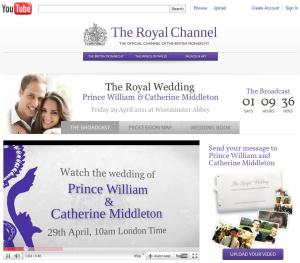
The Royal Family itself is getting with the times and announced that all coverage of the wedding will be on its very own YouTube channel. Coverage starts at 7pm Brisbane time!
And finally, it’s a friend of a friend but this spoof music video of ‘K Mid’ rapping about her 99 Problems is ‘totes’ worth a watch!