Two brains are better than one: The benefits of brainstorming
Public relations is an industry in which professionals must constantly develop creative solutions to problems, generate clever ideas to increase brand awareness and find a way to make a brand newsworthy when in reality there may be nothing new happening at all.
This is where brainstorming steps in to make the impossible, possible. Brainstorming is where a group of people bounce ideas off one another in order to foster creativity and generate solutions to a problem. There are only so many times one person can pull new ideas out of nowhere and that is why brainstorming is such an effective tool in public relations.
The main aim of brainstorming is to build on and extend others’ ideas. It is quite common for a number of ideas to be rolled into one. It’s not about one person coming up with the best idea.
In order to get the most out of an idea generation session consider the following tips next time you sit down for a brainstorm.
Know what you want to achieve- have a goal or outcome that you want to achieve from the creative thinking session.
Set a time limit.
Conduct the brainstorm in a calm and friendly environment.
Have one person record the ideas on writing materials that can be seen by all such as whiteboards or easels.
Create a relaxed space that fosters creativity and playfulness. Provide things such as food, comfortable chairs or a talking stick or object (a ball is easy to get around a room).
Focus on quantity of ideas.
Have people brainstorm individually before the creative thinking session then come together and build on these ideas as a group.
Refrain from judging and/or criticizing others’ ideas.
Only sort through and narrow ideas at the end of the session.
Encourage creativity. It’s equally as important for participants to come up with reasonable, valid suggestions as it is for them to generate crazy and outlandish ideas- sometimes what may seem like a wild idea at first is actually a great solution to the problem.
There are also patterns that arise in creative thinking sessions that hinder the process so make sure to look out for the following during your next brainstorm.
AVOID : groupthink
“Groupthink” occurs when a team of individuals settle on a single idea rather than continuing to generate new ideas as the single idea was accepted by the group as a good solution. This act boils down to a person’s desire to be socially accepted by their peers. Individuals would rather agree with something they don’t whole heartedly believe in than risk exclusion by challenging an idea.
AVOID : social loafing
Social loafing can be explained like this: put one person in a room by themselves and give them a task with a deadline. Then put two people in a room and give them the same task and deadline. Who will be more productive? The team or the individual? Social loafing is when individuals put less effort into a task due to working in a team.
SOLUTION: mind mapping
Mind mapping allows for ideas to be generated individually before the group comes together to brainstorm. It involves writing down a word or phrase and getting each person to build on the original theme and map out their thought process. Everyone then brings their mind map to the group brainstorm and after all the ideas have been shared, the team can evaluate as a whole. This reduces the risk of groupthink and social loafing.
Check out some other great articles on brainstorming :
“I don’t have a creative bone in my body” is something we’ve heard a few times. Luckily not in the office, as being creative and having good ideas are all part of a PR professional’s role. But we believe that everyone can have great ideas, it just takes some facilitating in the form of a ‘brainstorm’ or ‘thought shower’ as the politically-correct police are calling it (apparently ‘brainstorm’ might affect epileptics).
Brainstorms are when a group of people gets together to come up with loads of ideas to solve a particular problem. The problem can be anything from “what can X company do next year to generate publicity?” to “what shall we call this event for client Y?” to “what new products can we develop?” – basically, anything. The aim of a brainstorm is to come up with as many different ideas as possible, some way out of leftfield, some things that have been tried before, and some that are just pure original brilliance, to come up with the best possible solution.
In PR and the marketing industry in general it’s important to think differently and come up with great ideas and new ways of doing things. We regularly brainstorm for clients and potential clients and even ourselves. But a word of warning, don’t just be creative for creative’s sake – the solution must be right for the problem and also the client. Here are our top five tips for effective brainstorming.
1) Establish an atmosphere for creativity
Select the room for the brainstorm, sometimes it’s good to get outside or away from the norm. Make sure it’s prepared and a relaxing place to be – play some music, have some refreshments available, make sure there are plenty of coloured pens and pencils, flip charts, sticky notes, paper, etc. Have any props you might need ready to hand. Ensure that it is decided beforehand who will document all the ideas – consider recording the brainstorm so that no ideas are lost. Make sure you have an agenda for the brainstorm and make sure you set a time limit from the outset so people know how long they need to commit to.
Consider doing some warm up exercises for five to ten minutes to create a more relaxed atmosphere and get people thinking laterally, for example:
Word association game: Everyone stand up in a circle facing inwards. Have a ball. The first person with the ball throws the ball to someone else in the circle whilst saying a word, e.g. carrot. The second person who receives the ball says a word that instantly comes into their head associated with the first person’s word, e.g. orange, whilst throwing the ball to the third person. And so on.
One word story-maker: Go round the group creating a story one word at a time, have signals that change the direction of the story, e.g. the story might be travelling clockwise round a group of people but by putting your hand up you can change the direction to be anti-clockwise. See whether you can actually create something coherent.
2) No idea is a bad idea – set the ground rules
If possible, give the participants the brief before the brainstorm so they can come with some ideas already. But make sure you just give an introduction to the problem, don’t plant any ideas to limit the thinking.
It’s important for the person chairing the brainstorm to establish the rules and manage the whole process, including reinforcing the rules.
BRAINSTORM RULES
Anything goes – don’t judge ideas, they can be possible solutions but they may also be something that stimulates another idea from someone else in the group, so no idea is a bad idea, every idea is equally important and valid
Encourage people to think as broadly and wildly as possible
It’s all about quantity not quality at this stage – you want as many ideas as possible
Encourage laughter and chat, but don’t allow criticism. And encourage everyone – don’t let one or two people dominate
Stay focused on the problem/ topic
3) Use different techniques
During the brainstorm you can just present people with the problem and get them to come up with ideas, but often there needs to be more structure to a session. There are many different tools and techniques to use.
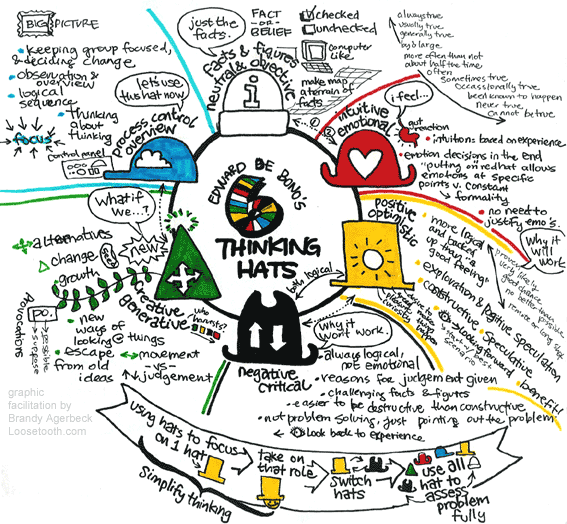
Six thinking hats: Developed by physician, author and inventor Edward de Bono, this technique advocates that everyone has to think a particular way at the same time. There are six different ‘states’ of mind – the six thinking hats – that have been assigned a colour. Switching mind state can be done literally or metaphorically by switching hat colour.
WHITE
Information – what information do you know, what information do you need?
RED
Emotions – what’s your hunch or feeling about something (without justification)
BLACK
Bad points judgement – why might something not work, use logic to identify barriers to success
YELLOW
Good points judgement – why something will work, use logic to identify benefits, why something might work
GREEN
Creativity – what are the possibilities, the alternatives, follow thoughts to new ideas
BLUE
Thinking – manage your thinking
All of these thinking hats are supposed to help everyone in a particular thinking hat stage think more deeply. They present problems and solutions about the ideas you might come up with.
Opposites: what is the worst possible solution to the problem? If you can think of the worst outcome, this may facilitate thinking about the best!
Flash cards: you know the children’s ABC flash cards with a letter and a picture of something? Well they’re great for brainstorms. Take a card and associate whatever you see on there with the problem in hand.
Random words: similar to flash cards, take a random word or thing and try to associate it in as many different ways as possible to the problem.
Personas: encourage people to think as if they were a different person – come up with various different personas to make people think about a problem from someone else’s point of view. This is quite useful if you work in an office where the demographic is very similar and everyone is thinking of solutions from their own point of view, it can introduce new thoughts and difference perspectives.
Other things you can do are:
Split into smaller groups, give each group a flipchart to brainstorm, move to the next flipchart and brainstorm around the ideas on there
If people are initially nervous about sharing ideas verbally, get them to write ideas on sticky note
If you’re planning a long session, have a break-out room with snacks and refreshments for breaks
Give people yellow cards to put down if someone is being too critical and a grey card when ideas are becoming too boring or mundane
4) Define and refine
At the end of the brainstorm, if there’s time, go through all the ideas and get everyone to vote on the five best ideas that can then be further developed. Or split all ideas into three groups – ideas that can work immediately, ideas that may work in the future with further development, ideas that just don’t or won’t work. If there isn’t time, make sure you sit down after the brainstorm session to do this.
Also after each brainstorm make a note of what worked well and what you think could have been done differently so you can hone the process and techniques you use.
Once you’ve had your first brainstorm you always have more to combine, extend or develop ideas from the first one, it doesn’t always have to be about coming up with brand new ideas.
5) Look outside the box
When choosing people to attend a brainstorm don’t restrict yourself to people in your office, think about bring outsiders into the brainstorm. If possible, make selections on who comes according to their expertise and interests, throw in some people from different business areas or with different skillsets as this might throw up something new.
The more you brainstorm, the better you get, it should be part of every pitch or planning process or just everyday business to unearth new ideas and ways of doing things and reinvigorate brands and businesses. Enjoy!
Share this post:
https://ignitepr.com.au/wp-content/uploads/2013/10/Ignite-WebLogo011.png00igniteprhttps://ignitepr.com.au/wp-content/uploads/2013/10/Ignite-WebLogo011.pngignitepr2011-04-13 11:40:592013-12-26 00:02:14How to run a brilliant brainstorm